

Industrial Safety Training System: What to Improve?
Traditional occupational safety instruction most often comes down to a lecture or video. The information is absorbed superficially, and after a week the employee no longer remembers how to act in an emergency. As a result, risks on the production floor remain high, and staff mistakes repeat again and again.
The issue is not people's inattention — it's the training format. When a person simply listens or watches, their brain does not create stable connections between action and consequence.
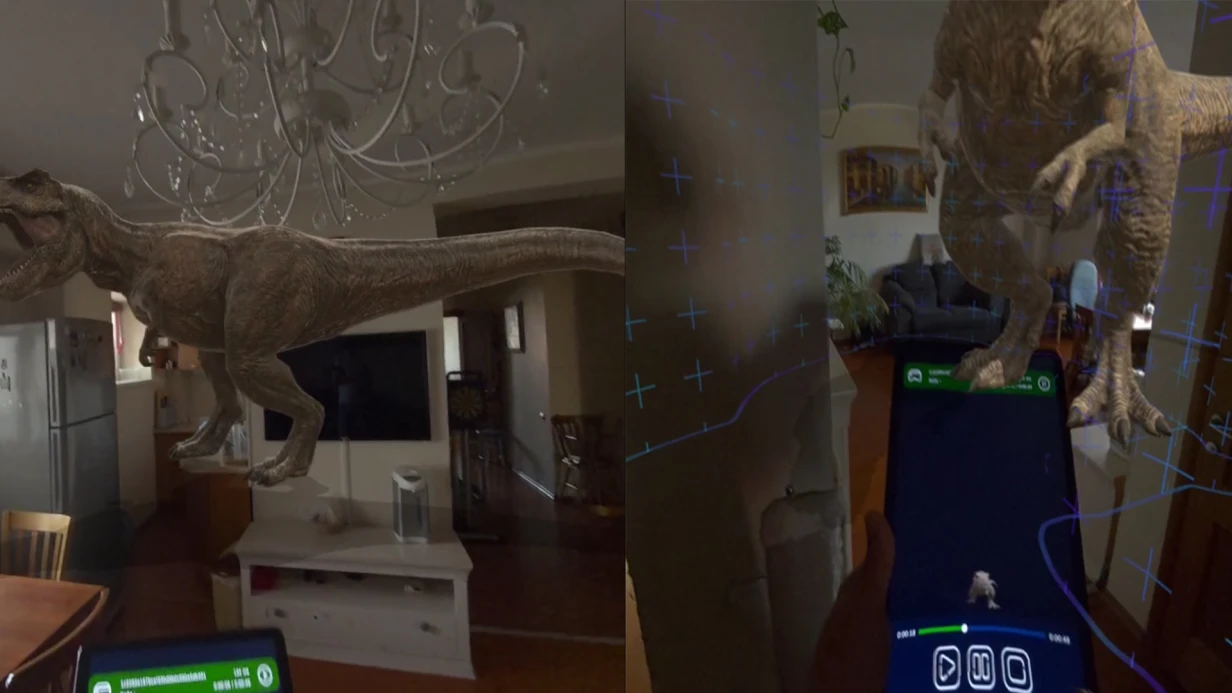
AR instruction moves training into a practical dimension: the employee sees the real workshop, equipment, and dangerous zones, but interacts with them safely. This approach reduces the number of errors already at the skill-practice stage.
The key advantage of AR for safety is the ability to simulate an emergency without threatening lives. The worker learns to respond to a leak, fire, or equipment failure in conditions as close to real as possible.
After such training, actions become automatic, and in a critical moment the person acts confidently rather than freezing.
If your industrial safety training system is not yet delivering the desired result — this is not a personnel problem, but a question of methodology.
Augmented reality closes the gap between theory and practice: it makes instruction visual, memorable, and safe for all participants in the process.
What Results Does AR Employee Training Deliver?
Classic briefings hold an employee's attention for a few minutes, and after a week less than half of the material remains. In production, the price of such forgetfulness is errors, injuries, and stoppages.
AR training changes the mechanics: a person does not listen to a lecture, but experiences a risky situation themselves in a safe digital environment. This engages muscle memory and emotional involvement — knowledge stays for years.
We develop an application based on ARKit that turns an ordinary smartphone into a personal occupational safety trainer.
The employee sees prompts, finds dangerous zones, practices actions during an accident — and all this takes place in the familiar workshop environment, not on abstract images. The result is measurable indicators that confirm the effectiveness of the approach.
| Metric | Effect | What makes it possible |
|---|---|---|
| Engagement | Up to 70% of employees complete the training | Game mechanics and realistic scenarios |
| Retention | Material is absorbed 40% faster | Practice instead of reading instructions |
| Safety | Up to 30% fewer errors in dangerous situations | Practicing actions without health risks |
| Time savings | Up to 25% faster onboarding briefing | Automated knowledge checks without stopping production |
Implementation does not require purchasing expensive VR headsets or powerful computers. The AR application works on tablets and smartphones that employees already have — you simply install the program and issue accounts.
This is especially important for companies with high turnover or seasonal workers: a new person can be brought into the process within one day.
You also get a control system: you can see who has completed the training, which topics caused difficulties, and who needs to repeat the material. Instructors stop spending time on paper logs, and the manager sees the current state of personnel training in real time.
AR Solution Formats for Industrial Safety Training
Industrial safety training is not lectures and brochures, but actions an employee must perform clearly and quickly in an emergency.
AR technologies make it possible to train such scenarios right at the workplace: a person sees real equipment with prompts, instructions, and dangerous zones overlaid on top of it. No risk, no production stoppage — only practice.
We select the AR instruction format for your tasks and budget: from covering all departments to practicing rare emergency scenarios. Below is how this works in different situations.
| AR Training Format | Who it suits | What it gives the customer |
|---|---|---|
| Mobile AR Application | Mass instruction of employees across the company | Employees complete training from their own smartphones at a convenient time — no separate classrooms or instructors needed, coverage of up to 100% of staff in a short period |
| On-site AR Instruction | New employees and workers on complex equipment | Overlaying prompts onto a real machine or mechanism — the person sees the sequence of actions and dangerous zones, onboarding errors decrease many times over |
| Interactive AR Simulators | Practicing rare and emergency scenarios | The team learns to act during depressurization, fire, or equipment failure without risk to life or machinery — response in a real emergency becomes faster and more accurate |
| Comprehensive AR+VR Scenarios | Managers, occupational safety specialists | Full immersion into an emergency environment with decision assessment — you can check staff readiness and identify weak points in instructions |
Which format should you choose? If you need to quickly train hundreds of people, choose the mobile app. If the priority is practicing actions on specific equipment, on-site AR instruction is suitable. For rare emergency situations, interactive simulators work best. We will help you decide, analyze your scenarios, and offer the optimal option for your budget.
How AR Training Implementation Works: Project Stages
AR training implementation may seem complex, but in practice it is a clear process with fixed timelines at each stage. We support the project from the first brief to launch and maintenance, so you get results without surprises.
-
Brief and task audit. We meet with you and the training team, define goals, audience, and scenarios. We clarify which employee skills need to be practiced and how AR will complement the existing program.
-
Design and approval. We prepare the solution concept, module structure, and work schedule. We align the details — you see what the training will look like and what results you will get.
-
Development. We create AR scenarios using proven technologies, with an interface employees can understand. Dangerous production situations are modeled safely and clearly.
-
Testing. We test the application on the customer's devices, in real lighting and movement conditions. We fix any flaws before the training goes into production.
-
Launch. We install the application, train the trainers, and hand over materials for independent use. Your employees can start completing modules immediately.
-
Support. We stay in touch: update content, add new scenarios, and refine the program when regulations change.
At the start, we set the timelines and team composition. This allows you to plan the training launch without being distracted by technical details.
What's Included in the Delivery of an AR Training Application
You receive not just an application, but a ready-made solution that can be used immediately in employee training. We put together the package so you don't have to figure anything out on your own: from installation to results analysis.
Here is what's included in the delivery:
- Mobile training app — adapted to your safety scenarios, works on tablets and smartphones the company already has.
- Interactive AR content — scenarios of dangerous situations and correct actions that employees practice in augmented reality. The content is developed around your production processes.
- Admin panel — you manage training: assign employees, grant access, monitor progress.
- Per-employee reporting — see who completed the training, how much time they spent, and what mistakes they made. This helps assess the team's real readiness.
- Instructor documentation — methodological materials and instructions on how to integrate AR training into your existing occupational safety system.
- Technical documentation and support — installation, updates, and administration without involving your programmers.
Reporting is a key part of the package. You get data that was previously collected manually: completion statistics, training time, typical mistakes. On this basis, you can adjust briefing programs and show management that training delivers measurable results.
The entire package is handed over in stages: first a pilot version for testing, then the final release and documentation. You always understand where the project stands and what you will get in the end.
Case Study: How AR Training Reduced Injuries at a Factory
At a factory with high injury rates, every new employee went through standard instruction: four hours of lectures, videos, and signatures in logs. After a week, most of the information was forgotten — dangerous mistakes started appearing on the line again.
The safety department spent time investigating incidents and could not keep up with monitoring the workshops.
We proposed replacing part of the instruction with interactive augmented reality training. A worker points a smartphone at a real machine and sees prompts on the screen: where the dangerous zone is, how to correctly pick up a part, what to do in an abnormal situation.
An error on the simulator does not cause injury, but immediately shows where the material needs to be reviewed.
The pilot results at the factory exceeded expectations: 240 employees were trained in one month, instruction time was cut from four hours to one and a half, and the number of errors on the final assessment dropped by 65%.
Over six months, injuries at the enterprise fell by 40% — primarily due to the correct actions of new employees in dangerous situations.
The factory's management quickly calculated the benefit: fewer sick leaves, fewer downtimes, fewer fines from regulators.
This case became a starting point: after the pilot, the company ordered an expansion of the AR program to three more workshops, and is now considering using the same format to train maintenance personnel.
How to Choose the Right AR Training Format for Your Task?
It all depends on what task the training solves and how many employees need to be covered.
If you are talking about regular instruction for dozens or hundreds of people, a full-fledged mobile AR simulator is optimal: it replaces part of the in-person sessions, works on employees' smartphones, and allows scenarios to be updated quickly without bringing in a contractor. This format pays off with a constant flow of newcomers and the need to track completion.
If the task is narrow — for example, practicing one dangerous area or holding a demonstration for managers — a short AR scenario of a few minutes is enough.
No complex server-side components or integrations are needed: we build a simulator app for a specific situation, and you use it on tablets or phones already available at the enterprise.
The choice of format is also influenced by how you want to evaluate the result. Some people accept a course completion report; others need to see the number of attempts, mistakes, and completion time for each employee.
The more metrics you need, the more sense it makes to invest in custom development with an instructor's personal account. For one-off events and open lessons, such options are excessive.
We help you decide on scope and budget at the brief stage: we analyze your scenario, the number of employees, and the desired update frequency, then offer a format that solves the task without overpaying.
Sometimes the right answer is a lightweight AR version of the instruction that integrates into the current training system rather than replacing it. In any case, you get a measurable result: reduced time for onboarding instruction and more conscious employee behavior on the site.
Common Doubts Before Ordering an AR Application
Before ordering an AR application for industrial safety training, many people have the same questions: how much does it cost, how difficult is it to implement, and when will a tangible return appear. That's normal — we hear similar doubts at almost every brief.
To address them, we briefly answer the three most frequent questions — no technical details, just the essence.
How much does development cost and what makes up the price?
The cost depends on the number of training scenarios, the complexity of the 3D models, and the need for integration with your existing training system.
But unlike purchasing simulators and equipment, an AR application is a product that becomes yours forever and scales to any number of employees without additional material costs.
Is it difficult to integrate AR into current training processes?
We make integration transparent: the app works on tablets and smartphones that your employees already have, and does not require restructuring the production cycle.
The first scenarios can be set up in two weeks, and we take on technical support and training for your team ourselves.
When will the project pay off?
The economic effect is visible after the first cycle: costs for renting training grounds, paying instructors, and printing handouts decrease. At the same time, employees make fewer mistakes — which means fewer downtimes and injuries. Based on our clients' experience, the project pays off within a year.
We have implemented dozens of AR and VR projects over 10 years, so we know how to turn training into a clear tool with measurable business results. If any doubts remain, we have collected detailed answers to the most common questions below.Get an AR Training Project Estimate Within 24 Hours
You send a request — and the very next day you receive an AR training project estimate for industrial safety. This is not abstract numbers, but a ready-made plan: scenario, budget estimate, timelines.
We deliberately speed up commercial proposal preparation to 24 hours so you can quickly compare options and make an informed decision.
Here is what the estimate will include:
- Analysis of your task and a description of how the AR format will fit into your existing safety instructions.
- A step-by-step scenario of the training module: what actions the employee will see and practice in augmented reality glasses.
- A cost estimate by development stage — from design to launch, with no hidden payments.
- Implementation timelines broken down by key milestones, so you understand when the training will go live.
- Recommendations on required equipment and software — only what is truly needed for your tasks.
- A clear commercial proposal with a fixed cost and cooperation terms.
- A description of how AR training will improve readiness and reduce the risk of injuries.
We do not just send numbers — we show how AR training addresses your specific task. After receiving the estimate, you can approve the project, adjust the scenario, or ask clarifying questions to our engineering and methodology team.
Send a request — and in 24 hours the estimate will be in your hands. If it is urgent, mention that in the comment: we will prepare the commercial proposal on a priority basis.