

Why do clients leave for competitors without VR interior design?
When a client chooses an apartment or office, they are buying not square meters, but a feeling of future life. Without VR interior design, they have to trust drawings and their own imagination — this is a direct path to doubts and dragging out the deal.
While the client hesitates, a more tech-savvy competitor is already showing the same property in an interactive format: the client walks through rooms, changes finishes, sees light at different times of day.
The result is obvious — the buyer goes where they are immersed in the future interior, rather than being forced to visualize it in their head.
Losing clients due to lack of VR interior design is not a one-off story, but a systemic problem. Competitors who have already implemented interactive design gain an advantage at every meeting: at presentations, when discussing floor plans, at the final choice between two options.
They don't sell a picture — they let you try the result. That's why in real estate and renovation, the share of deals after such presentations is noticeably higher: a doubting client becomes confident because they see their future home before investing money.
The stakes are not just lost profit. Every departed client carries away a story they will tell friends and colleagues: "it was beautiful there, but at the other place you could interact with everything." This works against you long after the failed deal.
Implementing VR is not a fashionable option, but a way to stay in that short list that the client seriously considers.
The good news is that you don't need to rebuild the whole business.
Consulting and audit of VR interior design implementation helps to understand where exactly interactive design will have the maximum effect — on the website, in the showroom, or in negotiations with a major client.
We help businesses in real estate and finishing be the first to offer the client the experience they seek — and close the deal before they leave for a competitor.
What benefits will your business get from a virtual showroom?
For a business selling interiors, the main problem is showing the client the result before money is invested. Standard floor plans and sketches don't spark emotion, and the decision drags on for weeks.
A virtual showroom relieves this tension: the client "walks" through the future apartment, sees light, materials, and furniture — and makes decisions faster.
We help implement VR interior design so you immediately feel the impact on sales. Here's what changes in your work:
-
Increased client loyalty. When a client sees their future home in detail, they stop doubting and start trusting you. Such clients return for new projects and recommend you to acquaintances.
-
Faster deals. Instead of long approvals and paper revisions, you show a finished picture and immediately get a response. The average deal cycle shortens significantly — that's a direct benefit for your pipeline.
-
Larger average ticket. In a virtual showroom, it's easy to show how the interior changes with more expensive finishes or furniture. The client sees the value and is more willing to agree to additional options.
-
Clear project visualization. You present not abstract drawings, but realistic scenes with accurate reproduction of textures and lighting. This raises the value of your service in the client's eyes and sets you apart from competitors.
-
Online presentation without meetings. The virtual showroom works over the internet: you can show a project to a client in another city or country without spending time on travel or showroom rental.
Take these five points as a checklist when implementing VR. We will help you configure the process for your business — from the first brief to launch. Book a consultation, and we'll show how a virtual showroom pays off in your niche.
VR interior design implementation formats for your task
Many companies are interested in VR interior design, but they are ready for implementation in different ways: some need a quick test on a real project, others need a full turnkey cycle, and others need to transfer the tool to their own team. That's why we work in three formats, and you pay only for the scope that solves your task today.
Below are the implementation formats, suitable audience, and business benefits.
| Format | For whom | What it gives the client |
|---|---|---|
| Express audit | For testing the potential of VR interior design without large investments | Sales process analysis, a pilot VR scenario, and a step-by-step implementation plan in 3-5 days |
| Full support | For implementing a VR showroom or interactive catalog | A project from task to launch: development, integration, support — a working tool that increases conversion |
| Team training | For sales departments and designers | Skills in working with a VR scene and approving floor plans — independence from contractors and faster deals |
Each format is aimed at a specific business result: reducing design approval time, increasing client trust, and raising conversion. The formats are easy to combine — start with an express audit, then move to full support or team training.
Importantly, in any format you work with a single team without subcontractors: we do the analysis, development, and launch ourselves. So you get a coherent result and support guarantees after implementation.
How a project goes: from brief to launch and support
Working on VR interior design is not magic, but a well-structured process. We've broken it into clear stages so you can control the project's progress and see what's happening at every moment. Below is a typical scenario that we adapt to your task.
Stages of work on VR interior design
- Brief and immersion in the task — we discuss why you need VR: to show interiors to clients, speed up project approvals, or present effectively at an exhibition. We record goals and expectations — this is the basis for all further decisions.
- Analysis and plan — we study your floor plans, design materials, and brand style. We prepare a work plan with clear deadlines and milestones so you see the project moving every day.
- Concept and scenario — we propose how the virtual space will work: which zones, how the user moves, what they can change. We agree on the concept before starting active development.
- VR application development — we create an interactive interior with a realistic picture and intuitive controls. You can already see the result on your devices during the process and evaluate how it looks.
- Approval and refinement — you test the application, and we make adjustments: change materials, lighting, layout. We work until the result matches your expectations.
- Launch and training — we connect the equipment, configure the system, and hand it over to you. In a short training session, we show employees the basic scenarios so they can conduct VR demonstrations on their own.
- Support and development — we stay in touch after launch: update the catalog, add new finish and furniture options, and help with updates and technical issues when needed.
This approach guarantees that you get not a "raw" demo, but a working tool for sales and presentations. You'll be confident in timelines and results — we take care of all technical complexities.
What's included in the delivery: a complete package for launching a VR project
Implementing VR interior design is not a one-off demo at a presentation, but a working tool for your team.
We deliver a complete package so you can launch the project without any finishing touches: from auditing current processes to ready-made scenarios that designers use from day one and clients see.
Here's what's included in the delivery:
- Report contents. Audit of your processes, growth points, and a VR interior design implementation plan with stages, timelines, and areas of responsibility.
- Scope of work. Setting up scenarios for typical tasks: showing floor plans, materials, lighting, interactive furniture rearrangement, and quick option switching.
- Documentation. Clear instructions for employees, operating regulations, update and backup rules — without dependence on narrow specialists.
- Consultations. Team training, reviews of real projects, and help with the first client presentations. You're not left alone with the tool.
- Service access. A workspace where scenarios, materials, and current versions are gathered. Technical support at the start and after launch so failures don't disrupt meetings.
- Launch support. Joint demos on real projects, adjustments based on feedback, and fine-tuning of scenarios in the first weeks of operation.
The entire package is delivered in stages: you see intermediate results and adjust them to your business tasks. At the end, you get a tool that accelerates project approvals, makes presentations more visual, and reduces the number of revisions on every project.
Case: how we helped a developer increase sales with VR
The developer Novostroy Development was selling apartments in a residential complex under construction, and showings were conducted only with paper floor plans. Buyers struggled to imagine what their future apartment would look like — most postponed their decision. The sales department spent an hour on each client, but conversion remained low.
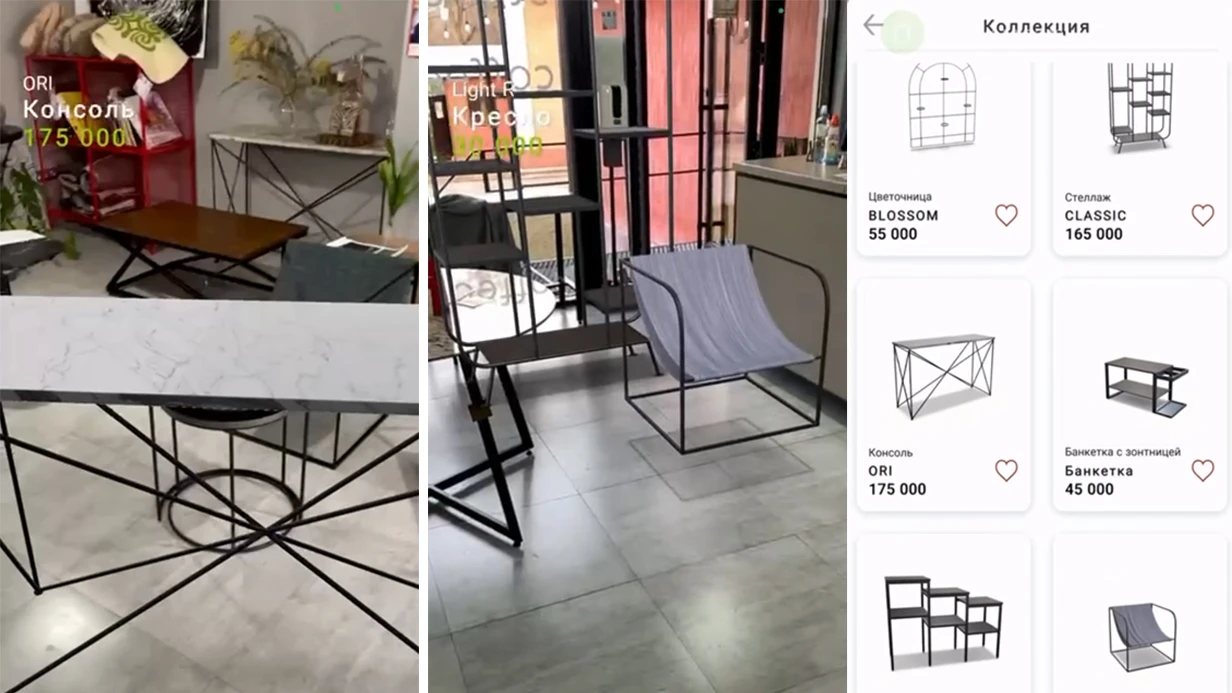
We offered the developer a virtual showroom based on VR interior design. Instead of flat drawings, the client put on VR glasses and "entered" the apartment: walked through rooms, changed the layout, finishes, and placed furniture. At that moment, the salesperson wasn't telling — they let the buyer explore the space themselves.
The results of the virtual showroom launch exceeded expectations. In two months of showroom operation, sales conversion grew 1.6 times: if earlier 4% of visitors made a purchase decision in one visit, after the VR viewing it became 11%. The average check increased by 18% — clients ordered larger areas and additional finishing options.
In addition, the deal cycle accelerated: the typical decision time dropped from a month and a half to three weeks. Seventy percent of buyers who went through VR design returned to the office for a second visit with a partner or family.
And the share of repeat referrals almost doubled — the virtual showroom became a separate reason to tell friends about the new development.
Based on the project results, the developer got not only sales growth, but also a clear tool for all stages of the funnel: from the first introduction to the project to choosing a specific apartment.
We still run this project today — we update interior collections, monitor statistics, and expand the virtual showroom for new buildings. The experience showed: selling apartments through VR is not technology for its own sake, but measurable business value.
How to choose the right implementation format for your task?
The format for implementing VR interior design is determined by three criteria: budget, timeline, and task scale. A small studio needs only one demonstration zone in a salon, while a branch network needs a centralized platform for all managers. Between these extremes, there are intermediate solutions that differ in both cost and launch speed.
| Format | When to choose | What it gives the client |
|---|---|---|
| Demo zone in a salon | Need to impress visitors and increase time spent at the point of sale | The client "enters" the future interior, and the manager gets a strong argument for closing the deal |
| Personal VR tour | Working with the premium segment and individual projects | The client sees the interior at full scale before finishing begins and approves decisions faster |
| Cloud viewing | Important to show the project to a client outside the office — at a meeting or online | Approval takes one or two sessions instead of a series of messages and revisions |
| Full implementation | A chain of salons or a design bureau with a constant flow of projects | A unified standard for presenting interiors at all locations, saving on renders and physical models |
The budget determines the entry point: renting a ready-made solution for an exhibition is cheaper than a permanent installation. If funds are limited, start with one typical scenario — for example, a kitchen or living room — that covers the main needs of your clients. This reduces cost and speeds up launch to a couple of weeks.
Timeline and scale affect the choice no less. A one-time event means a demo zone format. Ongoing work with buyers is an investment in a permanent solution. For multiple branches, a cloud interior library is more reasonable than separate equipment at each location.
In summary: choose a format for the task, not for the technology. Put together a short brief — project volume, geography, and demonstration frequency. Based on it, we will propose the optimal implementation for your budget and timeline within 2-3 days.
Frequently asked questions and client concerns about VR implementation
When a client hears about implementing VR interior design, the first thing that comes to mind is "it's expensive, complicated, and I'll have to buy equipment." These fears most often stop a project at the discussion stage, even though payback and guarantees can be easily calculated in reality.
We have been resolving such objections for ten years even before work starts. That's why we've collected answers to the four most common questions — so you can see the result, not the technical difficulties.
Do I have to buy expensive equipment?
No. We work with what you already have: a client's laptop or computer, and for a demonstration — an ordinary smartphone or tablet. If a fully immersive format is needed, we rent headsets for the event — that's 3-5 minutes of setup, not an expense item.
How quickly will the first result appear?
We'll show the first interactive scene within 3-5 business days after the brief. A full project for an apartment or office — from two weeks, including all revisions. You see intermediate versions at every stage and make changes before the final handover.
What about payback?
A client makes decisions faster when they see the future interior "live." In practice, this reduces the deal cycle by 2-3 times and lowers the number of failed revisions.
For design studios, a VR presentation becomes an advantage over competitors and a reason for repeat orders.
What guarantees that the project won't stall?
We work in stages with results fixed: you pay only for the accepted stage. The contract specifies timelines, scope of work, and revision terms. If something goes wrong, we return money for an unfinished stage — but in ten years we've never had to resort to that.
If you still have doubts — just write to us. We'll prepare a calculation for your task within one day and show you examples of projects in your niche so you can evaluate the result before any investment.Get a free consultation on VR implementation
Leave a request for a free consultation — even in one conversation you'll understand how VR interior design will speed up sales and reduce risks at the site. No need to understand technical details: we'll review your situation in business language and propose a clear action plan.
Immediately after contacting us, you'll receive:
- Express assessment of your task: whether a VR format is suitable for your direction, work model, and budget.
- A first-step plan: from a pilot project to full implementation in your processes.
- Transparent answers on timeline, cost, and team composition — without technical fog.
- Examples of implementations in interior design: similar cases, numbers, and real results.
- A personal consultant for communication — they will accompany you from the first call to the solution launch.
- Fixed terms for the next stage — no hidden surcharges or surprises.
Contact us in any convenient way: leave a request on the website, write to a messenger, or call. From there it's simple: we talk on a call, clarify details, send a proposal — and you make a decision calmly. No obligations, only benefit for your business.