

Why Pharmacy Chains Without VR/AR Are Losing Customers
A pharmacy customer doesn't just want to get a medication — they want to quickly understand what suits them.
Without interactive solutions, pharmacy chains face a problem: the pharmacist spends time explaining, the customer hesitates, and ultimately leaves — either choosing a cheaper alternative or postponing the purchase altogether. This is a direct loss of customers and revenue.
This is especially acute against the backdrop of online pharmacies, where comparing medications takes one click.
An offline location without digital tools loses the competition: the customer doesn't return, and the chain loses repeat sales, which account for the lion's share of profit.
VR/AR solutions for pharmacies change this. An interactive display shows composition, effects, and contraindications right on the screen, and an app can match a medication to symptoms in a couple of minutes.
The customer doesn't need to read fine print or wait for a consultation — they get a clear answer and trust the chain.
These tools also work for retention: a person who could quickly figure out the assortment returns to the same pharmacy. The young audience that expects a digital format also goes where there's product interaction, not just a shelf.
We help pharmacy chains implement VR/AR solutions — from interactive displays to medication-matching apps. We close the problem of lost customers and make the consultation process fast and clear.
What Opportunities Do VR/AR/MR Applications Open for Business
Accelerated Staff Training
New employees come to a pharmacy with different experience levels, but service standards must be uniform. Instead of long lectures and manuals, VR applications immerse the pharmacist in real-shift scenarios: receiving goods, consulting visitors, working with prescriptions.
This approach shortens the onboarding period several-fold and reduces the number of errors in the first months of work.
The load on supervising pharmacists also decreases: one specialist can train several people simultaneously, and practice of complex cases takes place in a safe environment. The employee hones skills to automaticity before serving real customers.
Sales Growth and Larger Average Ticket
Virtual reality trainers allow practicing additional sales, recommendations of over-the-counter medications, and handling objections. The pharmacist learns to hear the customer's need and offer related products — from vitamins to care products. This directly affects the revenue of every location in the chain.
Additionally, AR elements on displays or price tags draw customer attention to promotions and new products. The visitor sees a hint on their smartphone screen, and impulse purchases become more frequent — without staff involvement.
Brand Recognition of the Chain
Interactive formats set a pharmacy apart from dozens of competitors. A special AR zone at the entrance or a virtual product try-on becomes a reason to take photos and share on social media — that's free reach among potential customers.
A modern image helps retain the young audience and shows that the chain cares about customers and follows trends. Innovations in pharmacy service build trust and create loyalty that brings customers back.
VR/AR/MR Development Formats for Your Company's Tasks
For a pharmacy chain, choosing a format starts not with technology but with the task. Do you want to show customers a new location before it opens, train employees, impress partners, or manage the chain in a unified digital model? Each scenario has its own VR/AR/MR format, and we select it for a specific result.
This approach delivers measurable value: audience reach, speed of bringing employees up to the required level, clarity for investors, and real-time control over the chain. The table below shows the typical formats most often ordered for pharmacy business.
| Format | For Whom | What It Gives the Client |
|---|---|---|
| VR pharmacy tour | Marketing department, customers | Shows assortment and services without an extra visit, increases reach and trust in a new location |
| VR training | Pharmacists, administrators | Practice service and communication standards in a safe environment, memorize protocols faster |
| VR/AR presentation | Partners, investors | Demonstrates the scale of the chain and development plans, makes negotiations shorter and clearer |
| Digital twin of the chain | Executives, analysts | Combines data from all locations into a single model, helps plan openings and optimize logistics |
This is not a complete list but a starting point. We help select the format for your task and, after launch, show how it affected the chain's metrics.
How We Create VR/AR Applications for Pharmacy Chains
For pharmacy chains, VR/AR solutions solve practical tasks: fast staff training, clear navigation for visitors, product presentation without physical samples.
To ensure the result actually works rather than becoming a "showpiece," we have built a transparent process — from the first brief to daily support. At every stage, you see what's happening and understand where time goes.
-
Brief and immersion into the chain's tasks. We analyze your processes: how pharmacists train, where queues form, how customers choose products. We record business goals — reducing staff onboarding time, increasing recognition, growing the average ticket. The output is a clear technical specification agreed with you.
-
Scenario and prototype development. We create the app logic: a virtual pharmacy tour, a training simulator, a medication presentation. We show you an interactive prototype — you see how the solution will look and work and can make edits before main production begins.
-
Creating the digital twin and filling it with content. We develop a 3D model of your sales floor or a standalone stand, upload current materials: packaging, instructions, promo videos.
Content is adapted to the chain's real assortment so that employees and customers perceive the virtual object as real.
-
Assembly and technical testing. We connect the interface, 3D scene, and logic into a single application. We verify stable operation on professional equipment to eliminate failures on launch day — at an event, in a training room, or on the sales floor.
-
Testing with real users. We invite your employees or visitors to test the application. We collect feedback, adjust scenarios, and speed up interface response. The goal is for the user to figure out the application without instructions and enjoy the process.
-
Deployment and launch. We install the application on your devices or provide access through rented equipment. We train administrators and provide short instructions for employees. We launch the solution on schedule — for a grand opening, exhibition, or training program launch.
-
Support and evolution. After launch, we stay in touch: we promptly fix bugs, update content for new products, and add functionality per your requests. You get not a one-off app but a working tool that grows with the chain.
What's Included in the VR/AR/MR Application Delivery
For a pharmacy chain, it's important not just to get an application but to get a ready-made solution that immediately impacts staff training, customer navigation, and brand recognition.
We put together the package so you don't have to worry about the technical side — everything is included in the project, launched within agreed timelines, and supported after delivery.
- A ready VR/AR/MR application for your task — a virtual pharmacy twin for staff onboarding, AR navigation for visitors, or an interactive display. You get a tool that solves a specific business problem, not a "demo for demo's sake."
- An admin panel that doesn't require programmers — your employees change the assortment, promotions, prices, and training scenarios themselves. No need to assign tasks to developers and wait for updates.
- Clear instructions for staff — short guides: how to launch the application, update data, monitor operation. Even an employee without a technical background can figure it out.
- Team training — we conduct a hands-on session using real scenarios from your chain: we answer questions and walk through typical situations. Staff starts using the solution right after launch.
- Application warranty — a fixed period during which we fix shortcomings and adapt the solution to changes in your chain free of charge. You're protected from unexpected expenses.
- Technical support — available by phone and messengers, we respond during business hours and help resolve any issues related to the application's operation.
- Maintenance and updates — we monitor compatibility with current devices and systems and refine functionality for new chain tasks as needed. The solution stays relevant a year and two years from now.
Case Study: VR/AR Solution for a Pharmaceutical Company
For a pharmacy chain with several hundred locations, the key task was fast pharmacist training and increasing customer conversion to additional sales. Classic onboarding sessions took up to two weeks, and new employees came to the counter unprepared. There were also display shelves with products that visitors simply didn't know about.
We developed a VR trainer for the pharmacy chain to practice service scenarios and AR navigation over the assortment for customers.
In the virtual environment, a newcomer goes through dialogues with "difficult" customers, learns to offer related products, and handle objections.
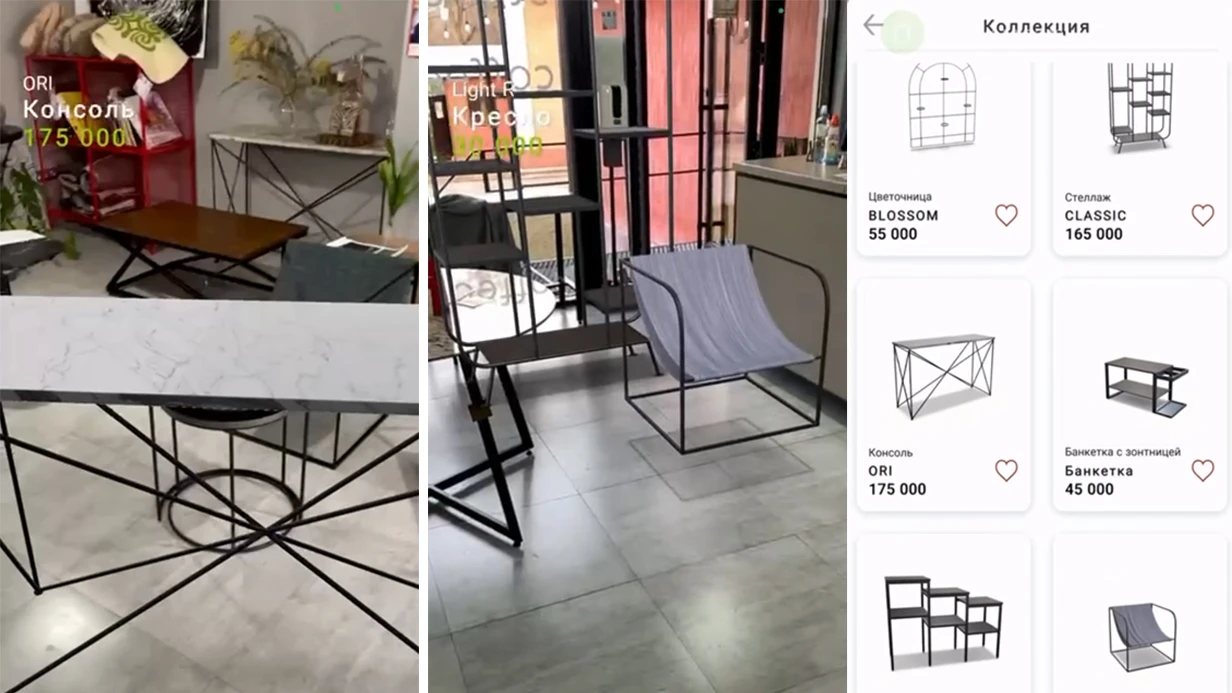
The AR module via tablet or smartphone shows composition, analogs, and contraindications — without direct pharmacist involvement.
The chain achieved a measurable result: employee onboarding time dropped from 10 days to 3, and conversion to additional sales grew by 27%. The average ticket at locations that used AR hints rose by 15% in the first month alone.
The number of placement errors halved — the trainer reinforced merchandising standards without a mentor.
The chain's management noted that the project paid for itself within three months — by reducing hiring and training costs. The company is now scaling the solution to all new locations, and we continue supporting it and updating scenarios for assortment changes.
This case confirms: properly applied VR/AR technologies deliver a fast, transparent, and repeatable result for pharmaceutical business.
How to Choose the Right VR/AR/MR Development Format for Your Task?
Choosing a VR/AR/MR format starts not with technology but with the task. For a pharmacy chain, this could be fast pharmacist training, clear product presentation, or a logistics digital twin before opening a new location. The goal determines which project will deliver value.
Need staff training — we choose a VR simulator: an employee practices working with customers in a safe virtual environment, memorizes medication storage rules, and passes a knowledge check.
Need to attract customers and boost recognition — AR fits: a customer points the camera at packaging and sees a video about the medication or a personal discount.
For planning new locations and optimizing flows, we use an MR twin: it connects the real sales floor with a digital model, showing bottlenecks before they become a problem.
Budget and timelines also matter. AR starts faster and costs less — it can be embedded into a website or app. VR is deeper and more expensive but delivers a controlled result in training. For one task, we'll propose two or three options with a clear difference in price and effect.
Think about who will use the solution. Pharmacists — simulators with knowledge checks and statistics. Customers — simple AR scenarios. Executives — analytics of shelf fill and queues in MR.
That's why you don't need to choose a format on your own. We start with a pre-project analysis: we discuss the task, audience, constraints, show a prototype, and estimate the budget. In the end, you get a format for your task, not "technology for technology's sake."
Frequently Asked Questions About VR/AR/MR Application Development
Before starting an AR/VR project, pharmacy chains have the same concerns: compatibility, timelines, security, and budget. We answer briefly and to the point — if you don't find your question, just write to us.
Is the application compatible with our devices?
The digital twin works on smartphones and tablets that visitors already have — no need to purchase special equipment. If needed, we connect AR glasses and sync with your catalog. The result is stable thanks to proven development tools.
Is it safe for customers and data?
We don't request unnecessary data: medication information is pulled from your system, and admin access is role-based. We use a secure connection. The scenario doesn't distract staff from work — it helps visitors find what they need faster.
What are the timelines and how do you control quality?
A typical project takes four to eight weeks. After the brief, we lock in a plan with milestones — you approve each result before we move on. Before launch, we test scenarios on the sales floor, with regular visitors, and on different devices.
How much does development cost and will there be hidden payments?
The cost is fixed in the contract after the brief and doesn't change during the process. You pay for completed stages, not for the "process." Post-launch support is already included in the estimate: we answer questions, make edits, and help update the catalog.
Order VR/AR/MR Application Development for Your Business
A pharmacy chain's day-to-day work is a stream of constant tasks: training new employees, reducing placement errors, attracting and retaining customers. A VR/AR/MR application turns routine processes into manageable digital scenarios.
The digital twin helps play out any situation in virtual space — from goods receiving to customer service — without risks and unnecessary reorganization costs.
When you order development from our team, we start not with code but with studying your business processes. We identify current bottlenecks and define the goal together — faster training, a larger average ticket, higher loyalty. The output is a proposal with concrete benefits for your chain, not abstract promises.
What you get with the finished application:
- Custom configuration for pharmacy chain tasks — from staff training to customer navigation.
- A digital twin of the sales floor: verify placement and logistics before implementation.
- Virtual simulators for newcomers: fast onboarding without taking them off the job or overloading mentors.
- AR content for customers: greater engagement in loyalty programs and navigation.
- A transparent plan with clear stages and checkpoints.
- A working guarantee and post-launch support.
Leave a request — we'll discuss your task and prepare a proposal where every benefit is tied to your chain's metrics. We work remotely across the country, with timelines and stages fixed in the contract. We'll start with a short call or brief — whichever suits you.