


Medicine Without VR: Why You Are Losing Patients
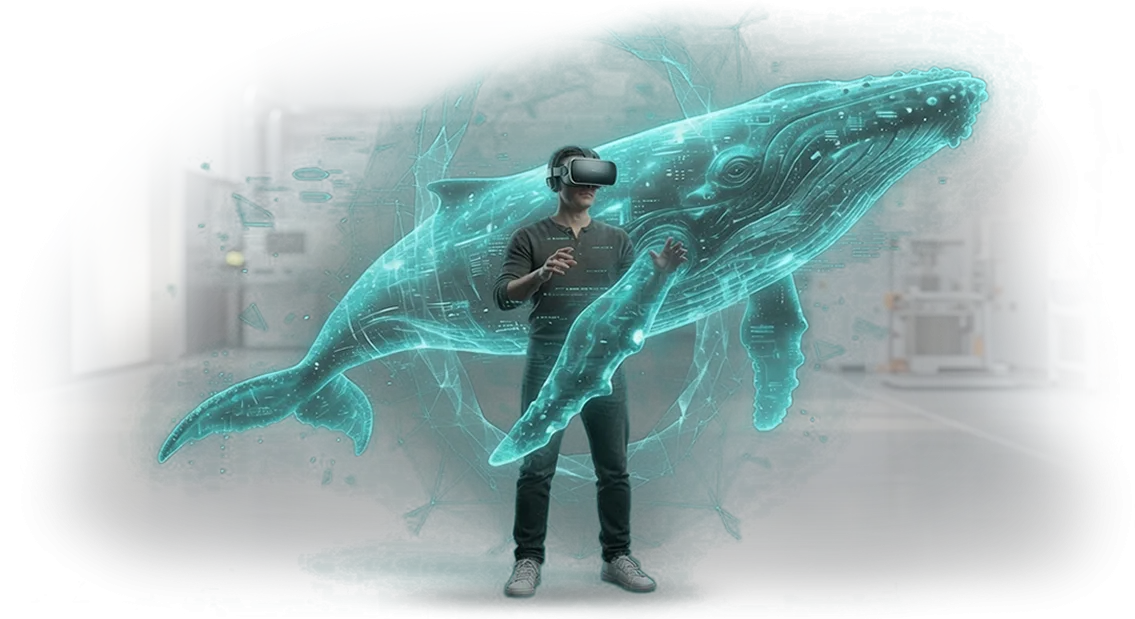
Patients choose a clinic not only for the qualifications of its doctors — first and foremost, they evaluate the impression made during the first visit and the level of technological sophistication.
If the neighboring clinic offers VR simulators for rehabilitation and interactive 3D models for explaining diagnoses, while you have paper posters and verbal recommendations, the choice is obvious. You are losing those who are willing to pay for a modern approach.
Falling behind digital standards costs more than it seems. Younger audiences are used to interactivity and expect medicine to be as clear and intuitive as their devices.
Meanwhile, competitors who have implemented VR for medicine gain a double advantage: they set higher prices for innovativeness and hold the position of leaders in patients' eyes. The result — your flow of patients goes where technology is already in use.
VR in medicine addresses key points of contact: patients stop fearing procedures when they see clearly what will happen and why. The rehabilitation process is transformed from monotonous routine into a game with visible progress — patients return on their own and bring friends.
And the clinic gains tangible metrics: higher loyalty, more repeat visits, stronger recommendations.
We help clinics stop losing patients because of outdated interaction formats. We develop VR applications for clinics that integrate into your existing process — from diagnostics to recovery — and deliver results from the first weeks.
Implementation does not require new skills from your staff: all management takes minutes, and the effect is visible to both doctors and patients.
Key Benefits of VR for Your Clinic
VR in medicine is no longer an exotic novelty. The advantages of VR for a clinic are obvious: higher patient engagement, faster doctor training, more effective rehabilitation.
We help create such solutions based on Meta Quest — professional equipment that delivers stable and safe results.
Patient Engagement and Loyalty Growth
When a patient puts on a VR headset, they are transported to a calm environment — this reduces anxiety before procedures and distracts from pain. Studies show that VR use reduces discomfort by 20–30%, and patients are more willing to return to a clinic that uses modern methods. This strengthens loyalty and leads to an increase in repeat visits.
Risk-Free Doctor Training
VR allows complex procedures to be practiced in a safe environment. Doctors train on virtual scenarios, which increases their confidence and reaction speed. The result — fewer errors in real practice and higher service quality. Training goes faster: staff master new skills in hours instead of weeks.
Effective Rehabilitation
For recovery after injuries and operations, VR creates interactive exercises that patients perform with interest. Gamified format motivates regular sessions, and doctors receive precise data on progress.
This speeds up recovery and increases the department's capacity: one specialist can manage more patients.
This approach turns a clinic into a center of modern medicine, where patients come with trust, and staff work more confidently and productively.
VR Application Formats for Different Tasks
VR solutions in medicine have already moved beyond experiments: they reduce training time for specialists, increase diagnostic accuracy, and make therapy more predictable. The key is to choose the right format for your specific clinical task, budget, and audience. Below are typical scenarios that clients bring to us.
| VR Application Format | For Whom | What It Gives the Client |
|---|---|---|
| Training and skill practice | Medical universities, training centers, residents, and practicing doctors | Safe practice of complex procedures without risk to patients. Students master algorithms faster, and the clinic gets consistently well-prepared specialists |
| Diagnostics and functional assessment | Neurologists, rehabilitation specialists, functional diagnostics departments | Objective data on cognitive and motor functions: balance, coordination, memory, attention. The doctor sees trends in numbers and makes more accurate diagnoses |
| Therapy and rehabilitation | Recovery centers, sanatoriums, mental health clinics | Engaging activities instead of boring repetitions — patients do exercises longer and more willingly. This accelerates recovery and increases loyalty to the clinic |
| Surgical planning | Surgical departments, orthopedics, maxillofacial surgery | The doctor “walks through” the operation on a digital model in advance, views anatomy from the right angle, and reduces the risk of errors. The result — fewer complications and a stronger department reputation |
| Inpatient patient care | Multi-specialty hospitals, pediatric departments | Distraction from pain and stress, preparation for procedures through play. Patients tolerate treatment more calmly, and staff spend less time calming them down |
We work on professional equipment, including Meta Quest, so we adapt each format to the target audience and clinic conditions. If you are not sure which option suits you — we will send a demo for your task, so the decision is clear even before signing the contract.
How VR Application Development Works
Every VR medical application project begins not with a headset but with a question: what practical task are you solving? Reducing risks during surgery, speeding up student training, rehabilitation after injuries, or clear visualization for patients.
The answer determines the scenario, interface, and team composition. We deliberately structured the process so that at every stage you see the intermediate result and can influence the product.
- Brief and immersion. We discuss your goal, audience, and constraints. We clarify where and how the application will be used: in a classroom, operating room, or rehabilitation office. The output is a clear technical specification and plan.
- Concept and scenarios. Together with your experts, we work out the interaction logic. For medical tasks, every detail matters: how the doctor selects a tool, how the patient responds to questions, what happens if a mistake is made.
- Prototype. We create an interactive mockup that you test on a Meta Quest headset. You see the interface and controls before full development — this lets you make changes while the cost of changes is minimal.
- Development. We implement scenarios, integrate graphics, sound, and feedback. We work on professional hardware and server architecture so the application runs smoothly without delays on target devices.
- Testing with doctors and students. We launch a pilot version with representatives of the target audience. We collect feedback and refine the interface, making it intuitive and safe for long-term use.
- Launch and support. We deploy the application on your headsets, train your staff, and help integrate VR training into the curriculum or clinical process. We stay in touch for updates and new scenarios.
Thanks to this approach, you can order a turnkey VR application without risking a “nice demo” that never takes root in the clinic. Each stage ends with a concrete artifact: from a plan and prototype to a tested product. You control deadlines and budget, and medical specifics remain in focus throughout the journey.
Turnkey Delivery of a Medical VR Application
The delivery package includes everything a medical institution needs for full use of the VR solution: from the finished product to staff training and technical support.
We work turnkey — you receive a working tool, not a set of promises. All documentation, source codes, and training materials remain yours.
This means you are not dependent on us in day-to-day operations: doctors and medical staff use the application independently, and technical support steps in only when truly needed.
What You Get in the End
- Ready-to-use VR application — fully configured for your clinical tasks, tested, and installed on the equipment. It is ready from day one.
- Source codes and all technical documentation — the digital assets belong to you. If necessary, you can develop the product with other contractors.
- Staff training — practical training for doctors and administrators: how to work in the VR environment, connect patients, and manage sessions.
- Instructions and procedures — short guides for staff, session start and end algorithms, checklists for patient preparation.
- Usage license — official right to use the application in clinical and educational activities without limits on the number of sessions.
- Post-launch support — incident assistance, interface updates, and issue resolution within agreed deadlines.
- Methodological recommendations — how to integrate VR sessions into existing protocols without disrupting the department's familiar processes.
This package covers legal compliance, team training, and further independent operation. You do not need to hire developers or dive into technical details — you get a tool that immediately benefits patients and makes staff work easier.
Case Study: How VR Helped a Clinic Reduce Patient Churn
Conventional rehabilitation often loses the battle with motivation: exercises are monotonous, progress is invisible, and after the first week some patients simply disappear from the schedule. For a clinic, this means 30–40% lost repeat visits and weak word-of-mouth referrals.
This was the exact challenge the NeuroRehab rehabilitation center brought to us: they needed to keep patients on a long-term recovery program.
We designed VR scenarios that turn movement into a game: patients perform exercise routines in a virtual environment, and the system automatically adjusts amplitude and pace to their current state.
No special hall was needed — training sessions were held directly in patient rooms and physical therapy offices, and doctors saw objective statistics for each set.
The results were predictable but impressive. Patient return for the next stages increased by 30%: nearly one in three, after completing one program, signed up for a new course.
The average rehabilitation duration shortened by 10–14 days — because people did not skip sessions and regained motor skills faster.
We should also mention word of mouth. Patients began bringing acquaintances, and doctors began to recommend the center more often: the VR method looks modern, is safe, and noticeably reduces fear of painful exercises. The clinic received an additional flow of initial visits without spending on advertising.
We are now scaling this approach to other medical tasks — preoperative preparation, chronic pain management, and pediatric rehabilitation.
If you want a similar patient-retention program, we will start with an audit of your departments and select scenarios for your specific patients.
How to Choose a VR Application Format for Your Task
Choosing a VR application is like choosing an instrument in an operating room: no one buys “just VR” — they buy a solution to a specific problem.
This is critical in medicine: training surgeons in a rare technique is one thing, preparing a patient for a procedure or speeding up rehabilitation after an injury is another.
The first criterion is the goal. If you need to practice motor skills, a full simulator with motion feedback works well. If the task is to introduce students to anatomy, an interactive trainer with scenarios is enough.
For patient education, a simple three-dimensional model that can be examined from all sides is often more effective.
The second criterion is the audience. Doctors value precision and speed, students value visual clarity, patients value comfort and ease. The interface, depth of immersion, and session duration depend on this.
For example, older adults do better with one short, calm scenario, while young specialists benefit from a multi-level system with tasks.
The third criterion is budget and timeline. A full multi-hour simulator requires more investment than a short demo. But you can always start with a prototype, test it with staff, and then scale. We help you choose an option that delivers results within your budget and deadlines.
The main point is not to choose a format “in a vacuum.” First, we establish who and what you want to teach, or which process you want to speed up, and then we propose a suitable VR solution. This helps avoid unnecessary expenses and get a tool that will be used every day.
Frequently Asked Questions and Concerns When Ordering VR Solutions
Any doctor or clinic manager exploring VR solutions for the first time faces the same questions: will the equipment break, will staff find it hard to learn the new tools, is it safe for patients, and will the project slip its deadlines. These concerns are natural, especially in medicine, where the cost of error is high.
Below, we address the most common concerns that clients bring to us. If your question is not on the list — that does not mean it does not exist. Write to us, and we will honestly explain how we solve your specific task.
Is it difficult to integrate a VR application into the clinic's current processes?
Integration is tailored to your clinic, not the other way around. We align the solution with your staff's familiar workflow: an administrator can launch sessions in a couple of clicks, and a doctor sees the result in an understandable format after each session. We train staff in one or two days — no special preparation is required.
Will the solution work with our medical equipment and facilities?
We work on professional Meta Quest equipment, which requires no cables or additional powerful computers. You only need to allocate a 3–4 meter zone in an office, and sessions can be conducted.
Before starting, we will analyze your facilities free of charge and show how the solution fits into the space.
How long does development and launch take?
A typical project takes 8 to 14 weeks, depending on the number of scenarios and diagnoses. You receive a phased schedule before launch, see intermediate results, and control the process.
Delays can only occur due to external factors — for example, if approvals are delayed on your side. We fix deadlines in the contract and stick to them.
Is it safe for patients, and is their data protected?
The VR load is dosed according to the patient's condition: session duration, intensity, and complexity are manually adjusted by the doctor. The solution has been validated in medical practice, so you get a predictable result with minimal risks. Personal data is stored on a secure server architecture, and only your clinic has access to it.
Is it expensive, and what results will we get for the money?
The cost depends on the number of scenarios, the range of diagnoses, and the required reporting. You can start with one pilot area and scale the solution once you see the financial return.
On average, a clinic recovers its investment within a few months — by attracting new patients and increasing the value of services through advanced technology.
Order VR Application Development for Your Clinic
Your patients remember not only the treatment but also the clinic's atmosphere. VR technologies help reduce anxiety before procedures, explain complex diagnoses, and make each visit more modern.
We develop VR for clinics fully turnkey — from idea to launch, taking into account the specifics of your specialty.
Virtual reality is already used in rehabilitation, dentistry, surgery, and psychotherapy — where it delivers measurable results in the form of reduced stress and faster recovery.
To order a VR application, you do not need to understand the technology: we handle all stages — scenario, design, programming, testing, and support. You get a ready-made tool that works for your clinic's reputation and patient comfort from day one.
We will discuss your task, show examples of medical solutions, and prepare a clear implementation plan.
By ordering turnkey VR development from us, you get:
- A custom scenario for your specialty — from dentistry to rehabilitation.
- Reduced patient stress: virtual reality distracts and calms patients before procedures.
- Faster doctor workflow: less time spent on persuasion and explanations, more time for treatment.
- A modern clinic image: patients share their impressions on social media, attracting new visitors.
- Full post-launch support: updates, help, and improvements based on your requests.
- A clear cost estimate before work begins — no hidden fees or unexpected expenses.
We have already helped clinics in various medical fields, and now we are ready to discuss your project. Leave a request — we will call you back, answer your questions, and prepare a personalized proposal with a cost estimate. Order your VR application right now and take a step toward a clinic patients happily return to.