

Quarterly Reports in VR: How to Turn Routine into an Event
Quarterly reports rarely generate enthusiasm — neither among shareholders nor among the team itself. The usual presentation in tables and slides overloads perception, and key figures drown in details.
As a result, the meeting becomes a formality, and important business questions remain without lively discussion.
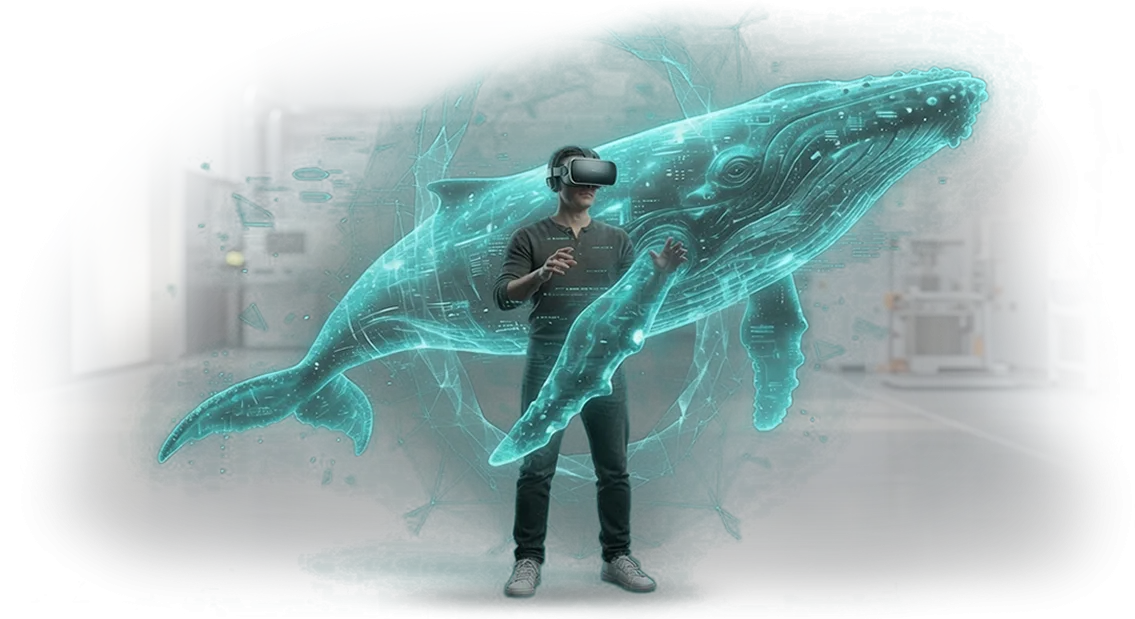
Virtual presentation changes this. We create a VR space where data looks visual: revenue growth, debts, and growth points appear as objects you can move around.
Shareholders don't just look at a chart — they interact with the information, and therefore perceive and remember it better.
Holding quarterly reports in VR format turns routine into an event: participants connect from anywhere in the world, see a living model of the business in front of them, and can change focus in real time, zoom in on needed blocks, and ask questions directly in the virtual scene. This shareholder engagement gives them a sense of involvement, not passive presence.
For a company, this is a way to position itself as a modern business that people trust. Our practice shows: at such meetings, participants maintain attention longer, ask deeper questions, and are less likely to ask to reschedule the discussion.
This means decisions are made faster and better — and this directly affects the speed of business development.
VR reporting already works in your industry: we have conducted virtual presentations for boards of directors and shareholders, and most companies return to us again.
If you are looking for a format that emphasizes business openness and strengthens investor trust, let's discuss your scenario.
What You Get from a Corporate Metaverse: 5 Business Benefits
The corporate metaverse is not an entertainment format, but a working tool for quarterly reports and board of directors meetings.
It replaces flat presentations and expensive in-person gatherings with a visual interactive environment where each participant sees figures, processes, and plans in real time.
First — savings on event hosting. You no longer need to rent large halls or pay for business trips and accommodation for executives.
All meetings take place in a single virtual space, so the budget for reporting meetings is reduced to a third, and preparation takes days instead of weeks.
Second — increased trust from investors and shareholders. Instead of dry tables, they see visual dashboards with indicators, can zoom in on details, and compare plans versus actuals in three-dimensional presentation. Such transparency convinces more than any slides and increases loyalty among key partners.
Third — participant engagement. People remember information better when they act rather than listen. In the metaverse, participants move around themselves, open data, and interact with models of products and projects. This reduces discussion time and accelerates decision-making.
Fourth — the image of an innovative company. Using a corporate metaverse noticeably distinguishes the brand against competitors: investors, partners, and journalists perceive it as a technology leader. This is an additional reputational effect that works for brand recognition.
Fifth — return on investment. The platform is created once but used repeatedly: quarterly reports, strategic sessions, training, presentations for partners.
Each subsequent event does not require additional expenses, so the project pays for itself within the first year — and then continues to work for your profit.
These are the five measurable advantages you get from a corporate metaverse. They turn routine mandatory reporting into a competitive advantage and a source of trust growth.
Corporate Event Formats in the Metaverse: For Any Task
A quarterly report and a board of directors meeting are different tasks, and in the metaverse each is solved with its own format.
Some need maximum engagement of key people, others need a visual presentation of results for hundreds of employees, and others need a combination of in-person presence and remote participants.
We select the format based on your business task, not "draw a pretty picture for the sake of a picture."
Below are the main formats we use in corporate projects. All of them run on professional equipment and proven tools, so the result is stable: no failures at the moment the entire board of directors is sitting in front of the screen.
| Format | For whom | What it gives the client |
|---|---|---|
| Virtual meeting (VR) | Board of directors, executive board, top management | Full immersion in the agenda: participants see data and each other in a single space. Decisions are made faster, and there's no need to travel to locations. |
| Augmented reality (AR) for reporting | Wide range of employees, partners, guests | Key indicators and results come alive right on a smartphone or tablet. No VR headset needed — maximum audience reach, and the material can be reviewed after the meeting. |
| Mixed reality (MR) | Hybrid teams: part offline, part online | Remote participants become a full part of the discussion, not a "picture in a browser." The boundary between the hall and the screen is erased — everyone sees the same information simultaneously. |
If your task is not just to report figures but to engage people in dialogue and ensure decisions are made the same day — we will assemble the right format.
It could be a fully virtual session for a small circle or a mixed scenario where part of the audience works with augmented reality.
Our metaverse platform is configured to your meeting format: from a strict protocol agenda to interactive discussion with voting and collaborative work with documents. You get not an "amusement ride" but a working tool that saves time and strengthens every presentation.
Board of Directors Meetings: VR Formats That Work
For the board of directors, what matters is not the technology but the procedure: quorum, minutes, confidentiality, and timeliness.
The VR format gathers participants from different time zones in one "hall," preserving familiar roles, speaking order, and access to documents. That is why we build meeting execution as a full project with clear checkpoints.
The VR meeting development process tailored to your format includes six stages:
- Brief and format — we record the agenda, number of participants, access rights, requirements for minutes, and time frames.
- Scenario and prototype — we design the virtual hall: places for speakers, screens with presentations, discussion areas. We show a mockup for approval.
- Content preparation — we adapt slides, reports, financial tables, and video fragments so they read well in virtual space.
- Assembly and configuration — we build the environment, configure access control, meeting recording, and automatic minutes generation.
- Test meeting — we conduct a rehearsal with your representatives: check timing, speaker switching, hand raising, and voting.
- Launch and support — on the day of the meeting we provide real-time support, resolve technical issues, and afterwards hand over the recording and materials.
The result is a board of directors meeting in a virtual environment where all formalities are observed and there is no loss of context. You save on business travel and receive a ready-made recording with automatic minutes.
The solution is easily scalable to regular VR meetings, shareholder meetings, and strategic sessions.
What's Included in Development: Delivery Package for Your Project
You receive not just a working application, but a complete delivery package that remains at your company's disposal. After project completion, you have everything needed to manage the corporate space, develop it, and connect new participants without dependence on the contractor.
What's included in the package:
- Ready-made corporate space for reporting meetings — a digital meeting room where executives connect from anywhere in the world, see a shared presentation, and communicate in real time. This is your permanent asset, not a one-time broadcast.
- Quarterly report scenario tailored to your format — agenda, speaker roles, synchronized slide presentation, and visual analytics on period results. The board of directors sees structured data, asks questions, and discusses results right in the space.
- Attendance and engagement analytics — which executives attended, how much time they spent on each block, what materials they opened. This data helps prepare the next meeting and assess participant interest.
- Training materials for the team and participants — a short guide, administrator instructions, and a demo recording. Employees master the space in one briefing without involving technical specialists.
- Technical documentation and regulations — systematized solution description, access credentials, update and backup procedures. You don't need to dive into details: all information is neatly handed over to your team.
- Transfer of rights and materials — you receive full rights to the created solution and can develop it independently or order new modules from us. No "closed" elements tied to a specific contractor.
- Post-launch support — warranty support and a direct communication channel so you can quickly resolve issues in the first weeks of operation.
The project is delivered on a "turnkey" basis: you get a predictable result, a trained team, and all materials for conducting quarterly reports and board of directors meetings at a professional level.
Case Study: Virtual Space for Top Management Meeting — Numbers and Emotions
Atlant — an international bank with 40 offices in Europe — faced a typical pain point: the quarterly report to the board of directors turned into a three-hour presentation with a pile of slides.
Top managers lost focus by the middle, key figures drowned in tables, and decisions had to be pushed through in the corridors. The request was not for a "trendy toy" but for a tool that would give each participant a clear picture of the business in one hour.
We built a virtual space for Atlant where executives enter from their work laptops — without special equipment or installing complex software. The report data came alive: revenue dynamics, regional clusters, risks, and scenarios — all visualized in volume, not on flat charts.
Participants move through the space, open the indicators they need, and immediately see how their decisions will affect profit.
We measured the results of this VR case together with the client. The board meeting was reduced from three hours to forty minutes, and decision-making time to two hours.
According to a post-meeting survey, 87% of participants noted complete understanding of the financial model — previously the figure was around sixty percent. A quarter later, the bank ordered another space, this time for the annual shareholder meeting.
"We expected a pretty picture, but got a working tool. The board of directors asks questions on substance rather than asking again what a bar on a slide means. This saves hours for everyone in the room," says the CFO of Atlant.
Efficiency is confirmed not by numbers but by habit: clients come back again. For top management, the virtual environment is not entertainment but a way to see the business as a whole and reach agreements faster.
That is why corporate metaverses are becoming part of regular management, not a one-time experiment.
Frequently Asked Questions About VR/AR/MR Development for Business
Before ordering VR/AR/MR development for corporate events, clients ask the same questions: how long to wait, how protected is the data, and will the solution work on existing equipment. Below are brief answers to four main concerns.
How long does development take?
Depends on scope: a basic environment for a quarterly report takes 3–4 weeks, a full corporate metaverse with data integration takes from 2 months. After the brief, we fix the timeline in the contract and stick to it. You receive a calendar plan with stages and a demo at each checkpoint.
How protected is board of directors' data?
We work under NDA and strictly maintain confidentiality. Data can be stored on your infrastructure or in an isolated environment; access is role-based in accordance with your security policy. Leakage is excluded — this is a separate condition in the contract.
What equipment is the solution compatible with?
We adapt the project to headsets from major vendors, as well as to the devices your employees already have. If you don't have headsets yet, we'll select optimal ones for your budget and tasks.
For remote participants, we provide access via browser or a lightweight application so as not to change familiar workflows.
What if we don't like the result?
We approve the scenario and visual style before development starts, and at each stage we show an intermediate version — you make edits without losing time. Final acceptance is carried out according to a checklist fixed in the contract. So you get exactly what you discussed, not "something similar."
Still have questions about timelines, security, or compatibility with your device fleet? Describe your task in the request form — we'll get back with a cost calculation and recommendations within one business day.How to Order Corporate Metaverse Development: Next Steps
Ordering corporate metaverse development doesn't require technical knowledge or a complex technical specification. It's enough to understand why you need a virtual space and what result you want to achieve.
We will propose a solution that fits your timeline and event format — whether it's a quarterly report or a board of directors meeting.
The process is structured so you always know what stage the project is at. Here's what you need to do:
- Contact us in any convenient way — form on the website, email, or phone call. Describe your task in two or three sentences: type of event, approximate number of participants, and desired timeline. That's enough for the first step.
- We'll invite you to a short call where we clarify goals, audience, and expected results. You'll get answers to questions about cost, timelines, and platform capabilities without any obligation on your part.
- After agreement, you receive a brief — a compact questionnaire taking 15–20 minutes. It captures the scenario, branding, feature list, and integration of necessary systems. Based on the brief, we prepare a detailed project plan.
- Approve the plan: stages, timelines, checkpoints, and responsible persons. We work transparently — you see progress and make edits at each stage.
- Development proceeds in parallel across multiple areas, including 3D environment, interfaces, and content preparation. You receive intermediate versions of the space and conduct test sessions with your team.
- After final launch, we stay in touch: help with technical support of the event, collect attendance and engagement metrics, analyze results.
The entire cycle — from brief to launch — takes from two weeks to two months depending on scope. At each stage, you work with a personal manager who translates business requirements into developer language and back. This way you get not a "raw product" but a working tool for management and communication.
How to Choose a VR Event Format for Your Task and Budget?
Choosing a VR event format starts not with the budget but with answering two questions: who are the participants and what result do you need.
A board of directors meeting with ten people and a quarterly report for hundreds of employees solve different tasks — so the environment should also be different.
There is no universal "correct" format, but there is a selection logic that protects against unnecessary costs.
For a closed executive meeting, focus, privacy, and the ability for live discussion matter. Here, a small immersive environment is justified, where each participant sees data, diagrams, and each other but is not distracted by outside noise.
This format accelerates decision-making and provides a sense of presence that a regular video call cannot convey.
A quarterly report for a wide team is about reach and ease of access. Employees from different cities connect to a shared virtual space where figures and plans are presented visually, and attention is held through changing scenarios and interactive elements.
Here, the budget works not on "expensive hardware" but on engagement: people actually watch, listen, and remember.
Calculate the payback of the VR format through business effect, not through session cost. If a meeting that previously required business trips and several days of coordination takes place in two hours in a shared virtual space, the savings are obvious.
If a quarterly report after moving to VR collects more live feedback and reduces time spent explaining indicators — that's also measurable benefit. A properly chosen format pays off already in the first cycle and then continues to work repeatedly.
We select the format for your task, audience, and budget, and at the pilot stage we show engagement and savings metrics. This way you make decisions based on numbers, not promises.