

Why property developers need VR/AR/MR applications for sales
Today's buyer is skeptical: they see beautiful renderings but cannot imagine what an apartment looks like in real life.
As a result, meetings in the sales office drag on, clients leave to “think it over,” and the marketing budget goes toward new leads that don't convert into deals.
Property developers need a tool that removes doubts before the contract is signed — and engages buyers better than paper floor plans.
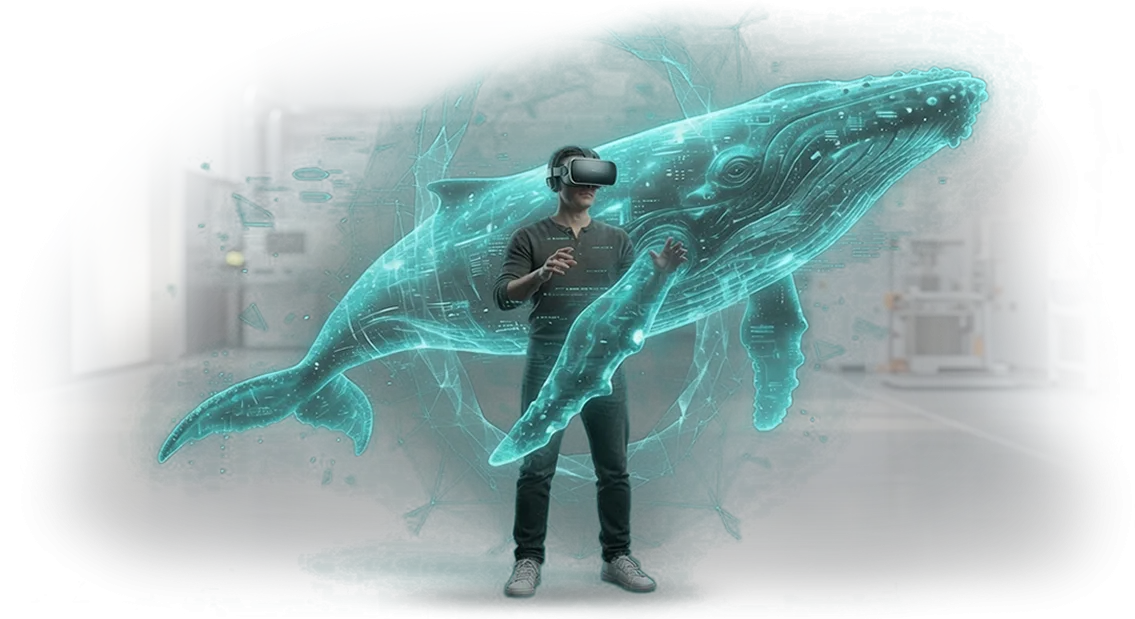
VR for developers, AR in real estate, MR for development — these are no longer experiments but working sales tools.
A virtual tour lets you “walk through” a future apartment, check the view from the window, move walls, or choose finishes — right on a tablet in the showroom or via a link from the buyer's own couch.
Interactive sales transform an impersonal catalog into a personal experience, and the experience into a decision.
The business benefit is obvious: the deal moves faster because the buyer arrives at the office already “in love” with the property. You reach clients in other cities, and those who can't come to the construction site see an exact copy of the future home.
For early-stage projects, such solutions sustain sales before the building is completed, and for premium-class real estate they create the image of a premium product.
We have been creating VR/AR/MR projects for business for over 10 years. We work with professional equipment and proven tools, so you get a stable result rather than a technical demo.
We'll advise which format — a virtual tour, an AR model in a show window, or a full MR space — will pay off fastest for your specific project.
What you get from implementing VR/AR/MR solutions
Implementing VR/AR/MR in property development is not a way to impress guests but a working tool that accelerates sales and raises the property's value in the buyer's eyes.
We have been creating such solutions for developers for over 10 years and know exactly what benefits they bring to business.
Sales growth and faster deals
A buyer makes a decision faster when they see not drawings but their future apartment. Mixed reality lets them “walk” through rooms, change the layout, and choose finishes — even before construction is complete. This removes the main doubts and shortens the time from the first visit to the contract.
Brand recognition and lead flow
At an exhibition or in a demonstration hall, an interactive zone attracts several times more visitors than ordinary stands. People gladly try out the layout, take photos, and ask about prices.
Visitors' reactions turn into leads for the sales department on the spot — without additional advertising investments.
Guest emotions and competitive advantage
A “walk” through a future residential complex is remembered far more than any brochure. The buyer tells friends about it, posts photos, and comes back to show the project to their family. For the developer, this is free reach and a reputation as a company that keeps up with the times.
While your competitors show pictures on tablets, you give the client an experience that is hard to forget. That is why projects with VR/AR/MR get more positive reviews and repeat inquiries.
VR/AR/MR project formats for development tasks
In development, the same project needs to be shown differently: to an investor — growth potential, to a buyer — the future apartment, to a contractor — engineering details. That is why we don't commit to a single format but choose a solution for a specific task. Below are typical scenarios that already deliver results at real sites.
| Format | Target audience | What it gives the client |
|---|---|---|
| VR showroom | Buyers in the sales office | Full immersion in the apartment before construction starts: the client “walks” through rooms, changes finishes, and makes a decision faster |
| AR tablet | Managers at the construction site | Overlay of a virtual floor plan onto real space — a clear way to show options without physical models or drawings |
| VR headset | VIP clients and investors | The effect of personally being present in the future property: high engagement and trust in the project |
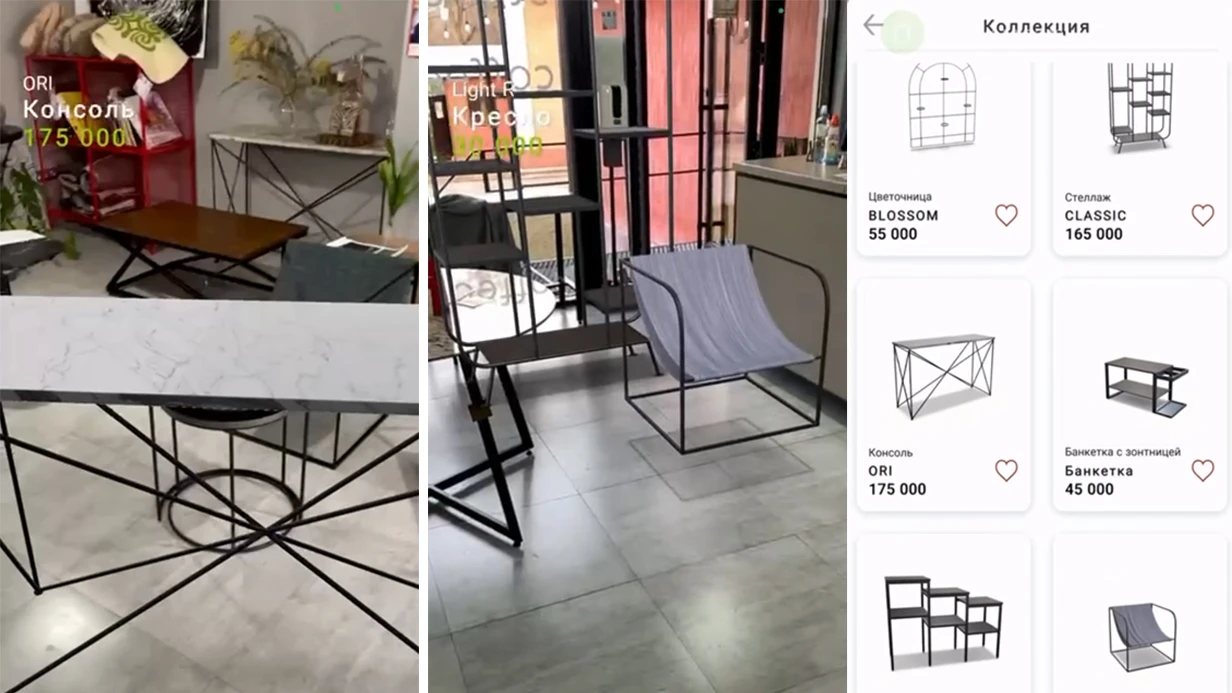
| Mobile AR app | Visitors to the sales office | The client points their phone at the model and explores floors in 3D — convenient and creates a “wow effect” they share on social media |
All formats work on professional equipment and integrate easily into the existing sales process. We help you choose the best option for your budget and audience — from a compact tablet to a full VR showroom that becomes the center of attention in the office.
How we deliver a VR/AR/MR project in 5 steps
For a developer, predictable timelines and a clear budget matter. That is why we structure our work as an open process: you always know what stage the project is at, what is already done, and what comes next. No “magic” and no hidden work — just five clear steps from brief to launch.
- Brief and task immersion. We gather information about your property, target audience, and project goals. We determine which format will deliver the maximum effect: a virtual tour for remote sales, augmented reality in the showroom, or mixed reality for architectural visualization.
- Work plan and cost estimate. Based on the brief, we create a concrete plan with stages, timelines, and cost. You receive a clear estimate with no hidden payments and can adjust the scope before development begins.
- Concept approval. We prepare the interaction scenario and key scenes, and show a prototype on your site. We incorporate revisions and approve the final version, so you know in advance how the solution will look for your clients.
- Implementation and control. We develop the application in stages and show intermediate versions. You comment, we quickly make changes — the project doesn't get shelved, and the result matches expectations.
- Launch and support. We help integrate the solution into your processes, train your staff, and provide support after launch. If further refinements or new scenarios are needed, we stay in touch.
A transparent process is your guarantee that you will receive a working presentation and sales tool, not an abstract development done “for the drawer.” Contact us for a consultation — we will analyze your task and offer the best format for your budget and timeline.
What is included in a VR/AR/MR solution delivery
You get not just an “app” but a ready-to-use working solution that fits into your processes from day one. It is a single delivery package covering every detail — from installation to staff training and future updates.
After launch, you are never left alone with the product: we support every stage and take responsibility for the result.
Here is what is included in the delivery:
- Ready-to-use VR/AR/MR application — for your specific scenario: showcasing a property under construction, training employees, or visualizing for clients. The application is already adapted to your equipment and undergoes final testing on site.
- Usage license — transparent rights management, no hidden fees or “fine print.” You operate legally and can use the solution in commercial activities without restrictions.
- Project source materials — the entire structure, database, and settings remain yours. At any time, you can hand the project to another contractor or continue development with an in-house team.
- Employee training — we train administrators and end users. Staff easily master the controls and settings, and the support team receives instructions for resolving common tasks on their own.
- Updates during the support period — we release system updates, add new features on request, and ensure compatibility with new hardware versions. You always use the current version of the solution.
- Technical support — available by phone and messengers during working hours. We answer questions, help with setup, and resolve issues promptly so your employees and clients don't face downtime.
- Manuals and documentation — clear guides for launch, operation, and administration. All materials are written in Russian and adapted to your team's skill level.
- Installation and setup warranty — if needed, we visit the site, perform commissioning, and make sure everything works exactly as you envisioned.
In the end, you get not a standalone file but a complete product with support at all stages of its lifecycle. This avoids “pitfalls”: no need to search for developers through ads, dig into technical details, or lose time on implementation. You focus on business, and we take care of the technology.
Case study: how VR helped a developer increase sales
For the developer “Severny Park”, we created a mixed reality application that lets buyers “walk” through apartments before construction is finished. Previously, clients saw only pictures on the website and a model in the office — this created doubts and slowed the deal.
With a virtual tour, the buyer immediately evaluates the layout, view from the window, and finishes, while the manager spends less time explaining and more time handling objections.
The project was launched in six weeks: we set up tours for four layouts, added floor selection and finish options. For the developer, this is not a “toy” but a working sales tool — managers use it in the office and send clients a link to view it on their own.
In the first two months, 340 buyers watched the virtual tours, conversion to visits grew by 37%, and the share of repeat inquiries reached 60%.
The result exceeded expectations: sales of apartments with VR presentations almost doubled, and the development paid for itself within four months of sales.
The developer's head of sales noted: “Clients arrive at the office already ready to buy — we stopped spending time on exchanging floor plans. The deal cycle went from two weeks down to three days.”
This case study shows that mixed reality works not as presentation decoration but as a tool that accelerates the purchase decision. For the developer, this means tangible savings on showroom maintenance and faster sales even during the construction stage.
How to choose the right format for your tasks?
The task is not to choose a “trendy format” but to solve a specific business problem. The answer to “how to choose a format” starts with goals: what should the user do — see an apartment before construction, check a weld seam, or avoid an error during installation?
There is no one-size-fits-all solution for development: presenting a future residential complex and quality control on a construction site require different tools, even though both are built on mixed reality technologies.
Choosing a solution depends on three things: the task, the budget, and the specifics of the property. If you need to sell apartments from the foundation stage, a virtual showcase of layouts and finishes is enough.
For a construction supervision department, MR overlays that show engineering systems on top of the real frame add clear value. And for a management company, the market offers solutions that clearly present properties with pre-sale finishes.
The budget also determines the scale: a one-time stand for a client day will cost less than a full platform used daily at all stages. However, it is important not to skimp on proper selection: an unsuitable format leads to downtime and slower decision-making.
At the start, we study your specifics for free — the number of properties, the construction stage, client requirements — and offer a format that solves the task without overpaying for unnecessary features.
As a result, you get not just an application but a tool embedded in your processes. If you are unsure, we can analyze your task within one working day and offer options with clear usage scenarios and implementation terms.
Frequently asked questions about implementing VR/AR/MR
Implementing VR/AR/MR in development is a high-profile step, and the same questions come up before launch: will we miss deadlines, will it work on our devices, who is responsible for the result. Let's address common concerns honestly, without technical jargon and with guarantees.
How long does solution development take, and will the launch be delayed?
A standard cycle takes two to eight weeks depending on scale: a simple VR apartment showcase is faster, while an interactive showroom integrated with the sales department takes a little longer.
We fix deadlines in the contract and deliver in stages: you see intermediate versions rather than getting a “result at the end.” If you need it by the sales launch date, we adjust the process to your calendar.
What are the risks during implementation, and what about data security?
The main risk is spending the budget on a beautiful demonstration that isn't used in sales. That's why we design the scenario right away for your managers and clients.
Data security is on our side: we work over secure channels and do not share commercial information about your properties with third parties. All materials remain your property.
Is the solution compatible with the hardware the company already has?
In most cases, yes. VR tours can be shown on ordinary laptops, tablets, and even in a browser — without buying expensive equipment. If you need virtual reality headsets, we will recommend the best models for your budget and help with the purchase. For AR scenarios, a smartphone or tablet that your clients already have is enough.
What happens if updates are needed after launch or something breaks?
We support the project after handover: we train employees, provide clear instructions, and stay in touch. The warranty on our work starts from six months, and technical support is available as long as you need it.
Minor edits such as new layouts or price changes are usually handled within the support scope — without separate estimates or lengthy approvals.
How difficult is it for managers and clients? Will anyone need training?
The controls are as simple as possible: tap the screen to switch floors, rotate the tablet to see the property at real scale. Training takes one short call, and then managers figure it out on their own.
For clients, the process is even simpler — they immediately find themselves inside the space and perform 30% more targeted actions than when viewing ordinary floor plans.
Order a VR/AR/MR solution today
Visitors remember emotions, while ordinary presentations leave almost no trace. VR/AR/MR solutions hold attention several times longer — both investors and buyers see your property in action.
If you are still only “looking into” mixed reality, a competitor is already convincing clients without you.
Leave a request and we will hold a free briefing: we will break down your task, suggest the right format, and give you timelines and a cost calculation. You will receive a clear plan, not abstract promises.
We have already completed dozens of projects for developers: virtual showrooms, sales applications, interactive exhibition stands. Our experience lets us accurately assess the complexity of the work and save your budget without losing quality.
When you contact us, you get:
- A free consultation and a detailed cost calculation for your development project.
- A personal demonstration of similar solutions — you see in advance what you will get.
- A team that understands the specifics of real estate: sales of apartments, commercial spaces, residential complexes.
- Professional equipment and proven tools — stable results for any venue.
- Post-launch support: assistance, enhancements, and training for your employees.
To order a VR/AR/MR solution, leave a request on this page. A manager will contact you within one business day, answer your questions, and prepare a personalized offer. We will start with a free consultation — all we need from you is your contact details and task.