

Textiles Without Augmented Reality Lose to Competitors
Today's fabric buyer is not willing to choose "blindly". They need to see how the material will look in a real room, how it drapes on furniture, how it behaves under light.
If your website only shows flat photos, the customer leaves for someone who provides an interactive experience. Augmented reality for textiles solves this problem: the buyer points the camera at a room and sees the desired fabric in their own interior. They can compare several options and choose the best one.
This presentation is not just convenient — it solves the client's main pain point: the fear of making the wrong choice. Virtual fitting shows how the fabric looks on interior items, and interactive fabric catalogs instantly display the entire assortment with precise detailing.
As a result, the number of orders grows severalfold, and returns decrease. The buyer stops hesitating and places an order right from their smartphone. Textiles without these tools lose, because the buyer chooses the one that provides confidence.
We already develop mixed reality solutions for textiles and know how to turn a catalog into an engaging experience. We help clients implement such solutions so they do not lose potential customers and can increase the average order value. Our experience shows that customers return for repeat orders when they see fabric in action.
Implementing immersive technologies is not an experiment — it is a market requirement. While you are hesitating, competitors are already selling through virtual fitting. We solve this task quickly and with a guaranteed result.
Immersive Technologies for Textiles: Key Benefits
Fabric buyers choose blindly: on a roll, the material looks different than it does in an interior. Curtains, furniture upholstery, pillows — it is hard to imagine how the fabric will behave under real lighting and in a real space. The result is doubt, postponed purchases, and returns.
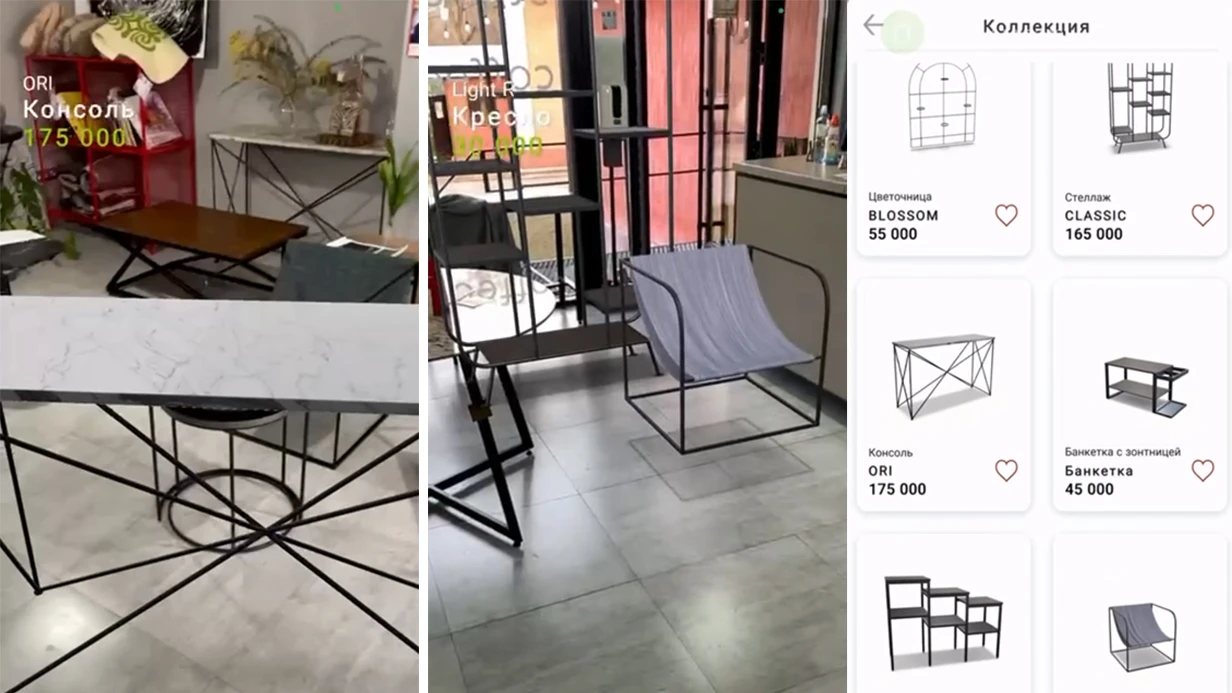
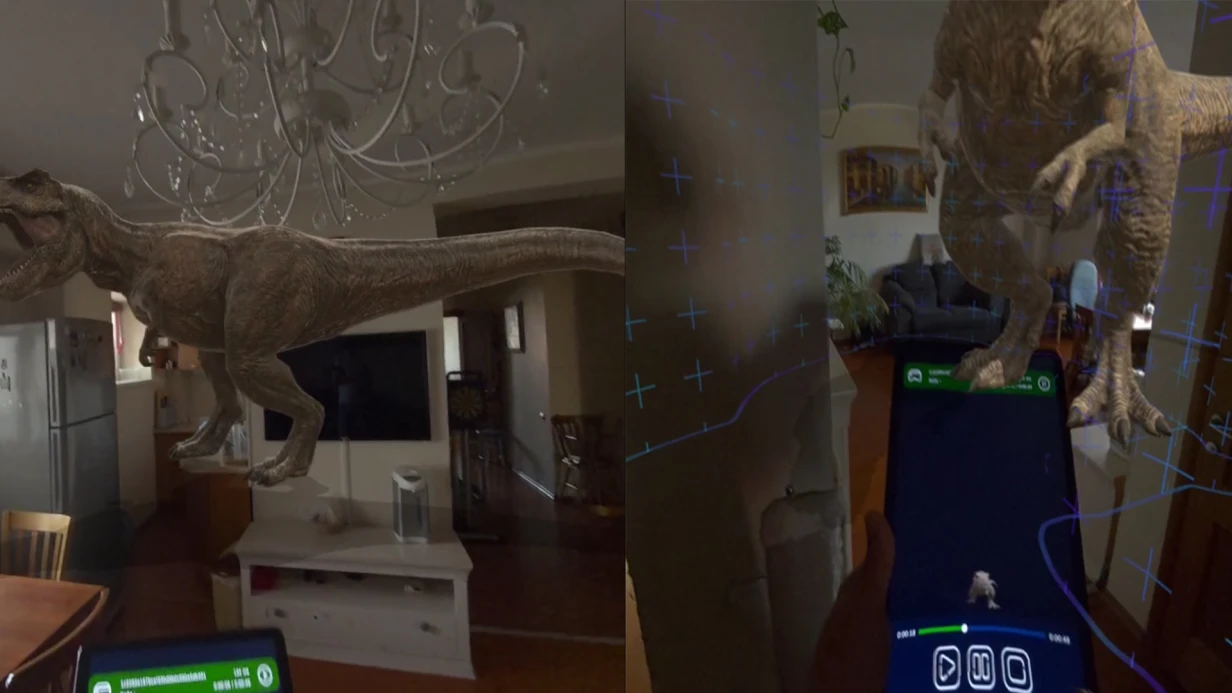
A mixed reality application solves this problem. Simply point your smartphone or tablet camera at the client's room, and the fabric appears in the real space: it drapes, forms folds, and reacts to perspective. This works both in the store and at the buyer's home when they are choosing from a catalog.
When buyers see the material "in action", their confidence grows. And confidence means higher conversion: less deliberation, faster decisions, higher average order value. Fabric stores using such a tool report a noticeable increase in orders and repeat visits.
The immersive format itself is a media hook. Visitors record the fitting, share it on social media, and this increases brand recognition without an additional advertising budget.
And an accurate representation of the material reduces returns — the client gets exactly what they saw on the screen.
We develop such MR solutions for textile manufacturers and sellers: from concept to launch on professional equipment. We will help you design a scenario that brings value to your customers and measurable results to your business.
MR Application Formats for Textile Business Tasks
Each format solves its own task: show the fabric in action, give the buyer a chance to "try on" the product, or turn a catalog into a live sales tool. We select the option for your business process so the technology pays off from the very first launch.
For clarity, here is a table of typical formats and their benefits for a textile business.
| Format | For whom | What it gives the client |
|---|---|---|
| Virtual fabric showroom | Wholesale buyers, designers, technologists | Savings on samples: the whole collection is always at hand, and you can examine texture and color under different lighting |
| 3D clothing fitting | Retail buyers, marketplaces | Higher conversion and lower returns: the buyer sees the item on their own figure before purchase |
| Interactive catalog | Sales managers, exhibition participants | Quick presentation of the entire product line without physical samples, and the ability to send the client a link after the meeting |
A virtual showroom is especially valuable for companies with a wide range of fabrics — it replaces dozens of physical palettes and allows partners from any region to study the collection without traveling.
And 3D fitting works as an additional argument in an online store: buyers make decisions more confidently when they see the fit and drape.
If your goal is to impress at an exhibition or launch a new collection, an interactive catalog with augmented reality will attract more attention to your booth and collect contacts.
The formats can be combined: for example, a showroom for wholesalers and a fitting room for retail — a single ecosystem covering the entire sales cycle.
We will help you choose the right format for your niche, build a prototype, and test it with real customers before scaling. This way, you get a working tool, not "technology for technology's sake".
Turnkey VR/AR/MR Development Stages
A transparent process is what distinguishes a reliable contractor from a "black box". We fix the stages of VR application development in the contract and show what you pay for at each step.
You always know where the project stands, when the first demos will appear, and what you will receive in the end — no surprises in timelines or budget.
- Brief and immersion into the task. We analyze the problem the application solves: fabric fitting, collection showcase, staff training, or interactive catalog. We record the goals, target audience, and success criteria.
- Concept and scenario. We develop the user scenario: how a person interacts with the object, what actions they take, and what they see. We determine the formats — VR, AR, or mixed reality — and the platforms on which the product will run.
- Prototype and design mockup. We create an interactive prototype: screen structure, transition logic, visual style. You see what the future solution will look like and how it will work, and you can make edits before full development begins.
- Application development. At this stage, we build the functionality: rendering 3D fabric models, interaction physics, and integration with your catalog or inventory system. We use professional tools and equipment — this guarantees stable operation on your users' devices.
- Testing on real devices. We check scenarios with your employees or a focus group: how convenient it is to use, whether there are any failures, and whether the controls are responsive. We collect feedback and bring the product to final quality.
- Launch and support. We publish the application in stores or set up installation for business tasks. We train your team, hand over documentation, and stay in touch: we maintain updates, add new materials, and provide technical support for the solution.
Project timelines depend on the complexity of the scenarios and the number of platforms — usually from 3 to 10 weeks. We fix them in the contract and stick to the schedule.
And to make ordering an AR solution simple, start with a short brief: we will come back with a cost estimate, timeline, and a first-step plan.
What's Included in the Delivery of a VR/AR/MR Solution
When you order a VR/AR/MR solution for the textile industry, it is important to understand: you are getting not just an application, but a ready-to-use working tool.
The delivery includes not only the program, but also all necessary documentation, employee training, and support at every stage of operation.
What does VR project development for textiles include? We hand over a complete package that covers all issues of launch and daily work:
- Documentation: technical description, user manuals, update regulations — everything your team can work with without developers.
- Employee training: practical sessions for operators, administrators, and managers, so that everyone confidently uses the system.
- Adaptation to your content: loading fabric catalogs, 3D models, and display scenarios — you get a solution filled with your own materials.
- Integration with your processes: connection to accounting systems, web catalog, or sales department, so data is updated without manual effort.
- Warranty on the solution: bug fixes, updates, and refinements based on your feedback during the warranty period.
- Technical support: a dedicated communication channel, consultations, and remote problem-solving during business hours.
- Scalability: an architecture that can be easily expanded for new tasks — new locations, collections, or interaction formats.
Additionally, we can include usage analytics: session reports, collection popularity, and recommendations for improvement. This way, you will understand exactly how your employees and customers are using the solution.
We deliver the project in stages, with checkpoints, and remain available after launch. You do not need to understand technical details — the solution works and delivers results.
Case Study: How Our Textile Client Increased Sales
The retail chain TekstilPro faced a typical pain point in textile retail: customers spent a long time choosing curtains or upholstery fabrics, but postponed the purchase because they could not imagine how the material would look in their room.
As a result, conversion to order dropped, and the share of returns for fabrics bought "by eye" reached one third.
We developed an MR application for them that "overlays" the selected fabric onto a real space through a tablet or smartphone camera — onto a window, sofa, armchair, or wall in the store.
The customer sees how the textile looks in texture and color, changes the lighting and viewing angle, and the consultant immediately sees which collection the guest is interested in.
Two months after the launch at pilot locations, conversion from visitor to buyer grew 2.4 times, and the average order value increased by 36% — customers began to buy not just one type of fabric, but a complete set.
The rate of returns dropped from 30% to 11%, and repeat orders within six months generated more than half of the revenue.
The case was implemented using professional equipment and refined mixed reality algorithms, so the image maintains accurate color and scale. This made it possible to quickly scale the solution to all stores in the chain and train the staff in just a couple of days.
Now TekstilPro officially states: "MR fitting has become the key argument for buying at our store." We are ready to deliver similar numbers for your niche — just show us where your customers most often "get stuck".
How to Understand Which Format You Need?
Choosing a format is not a question of technology, but a question of results. The answer depends on three things: what task the solution solves, who your audience is, and what budget you are ready to allocate.
The same product — for example, a textile collection — can be presented in completely different ways depending on what matters more: impressing an exhibition visitor, training a manager, or shortening the sample approval cycle.
If the task is a striking presentation of new items at an exhibition, a light AR filter that "brings to life" a fabric sample right in the guest's hands is enough.
If you need to immerse the client in an interior atmosphere and show how the fabric looks in a finished product, a VR presentation works better.
An MR solution occupies an intermediate position: it allows you to combine virtual images with real space, which is convenient when working with catalogs or mood boards.
Determine who will use the solution. For a mass audience at an event, simplicity is key: a person must understand what to do within 10 seconds, or they will move to the neighboring booth.
For designers and technologists, in contrast, deep interaction is valuable: the ability to change color, scale, and examine texture. These scenarios require different formats and different levels of detail.
Budget and timeline are honest constraints. A full-fledged VR application will require more time and investment than an AR filter or an interactive 3D presentation.
But if you calculate ROI — for example, how many brand contacts each zone generates — the more expensive solution often pays off through reach and repeat inquiries. We can prepare two or three options for your budget so you compare them by value, not by picture.
We help you decide during a free consultation: we analyze your task, audience, and budget and suggest the format that will deliver maximum impact. Write to us — we will recommend which VR/AR/MR option suits your business, and give you guidance on cost and timeline.
Answers to Frequently Asked Questions About Development
Every project starts with questions — about budget, timeline, and results. For the textile industry, this is especially important: the client needs to understand how the technology will pay off at an exhibition, in a showroom, or in production. Below, we address the most common concerns we hear from business owners and marketing directors.
How much does VR/AR application development cost?
The cost depends on the format: a demo mode for an exhibition, an interactive catalog, or a complete solution for employee training. We prepare a transparent cost estimate after the brief and always show what you pay for — scenario, content, programming, and support. No hidden fees.
What is the launch timeline?
A basic application for showcasing a collection can be launched in 3-4 weeks if the scenario is clear. For complex projects — with integration into the product database or staff training — we allow from two months.
At every stage, you see intermediate versions and can make edits without waiting for the final delivery.
How difficult is it to implement the technology?
On the client's side, you only need to provide materials: fabric photos, collection descriptions, and a logo. We handle everything else — prototyping, equipment setup, testing.
At launch, we train your team or work as a contractor at the event, so you do not get distracted from your core work.
What if you do not like the application?
We start with a concept and show the scenario before full development. If at this stage you realize the format is not suitable, we change it without losing budget. In the contract, we set key approval points so that you control every step.
Can the application be updated after launch?
After project delivery, we stay in touch: we add new collections, edit content, and adapt the solution for other events. Many clients return with a repeat order — this is normal practice because the technology has already shown results.
Order VR/AR/MR Development for Your Product
Fill out a short brief — it will take 10-15 minutes. Based on it, we will prepare a cost estimate and a work plan for your task.
What happens after your request:
- Days 1-2 — we study the task, clarify details and project goals;
- Days 3-4 — we prepare a commercial proposal and a preliminary estimate;
- Days 5-7 — we fix the timeline, scope, and launch the project;
- In 1-2 weeks — we show the first version for testing;
- After that — iterations, launch, and support.
We work remotely, so you do not need to visit the office: all calls, approvals, and demos happen online.
| Stage | What we do | Your result |
|---|---|---|
| Brief and analysis | We immerse ourselves in the product and audience | Understanding of how to solve the task |
| Estimate and plan | We fix the cost and timeline | Transparent estimate without surprises |
| Development | We build a prototype and a first version | Live demo access |
| Launch and support | We train, support, and update | A working solution |
We have already completed more than 40 projects in the textile and retail sectors. For one client, we created an AR fitting that attracted 3,000 new users in a month and increased repeat orders by 15%.
Bottom line: leave a request through the form. In 2 days, you will receive an estimate, and in another week the project will be launched.