



Customers can't see furniture in their own interior and delay their purchase
When a customer chooses furniture, they can't see how a sofa or wardrobe will look in a real room. Even exact dimensions and high-quality photos don't remove the main doubt: will this match my walls, floor, and lighting?
As a result, the decision is postponed, and the customer leaves to "think it over" — most often heading to a competitor.
For a furniture store, this means direct revenue loss and low conversion. The customer returns to the site several times, compares, hesitates, asks for additional photos and measurements — and still doesn't decide to place an order.
Each such cycle costs managers' time and brings no sale, while the visitor eventually chooses a more "visual" option from another seller.
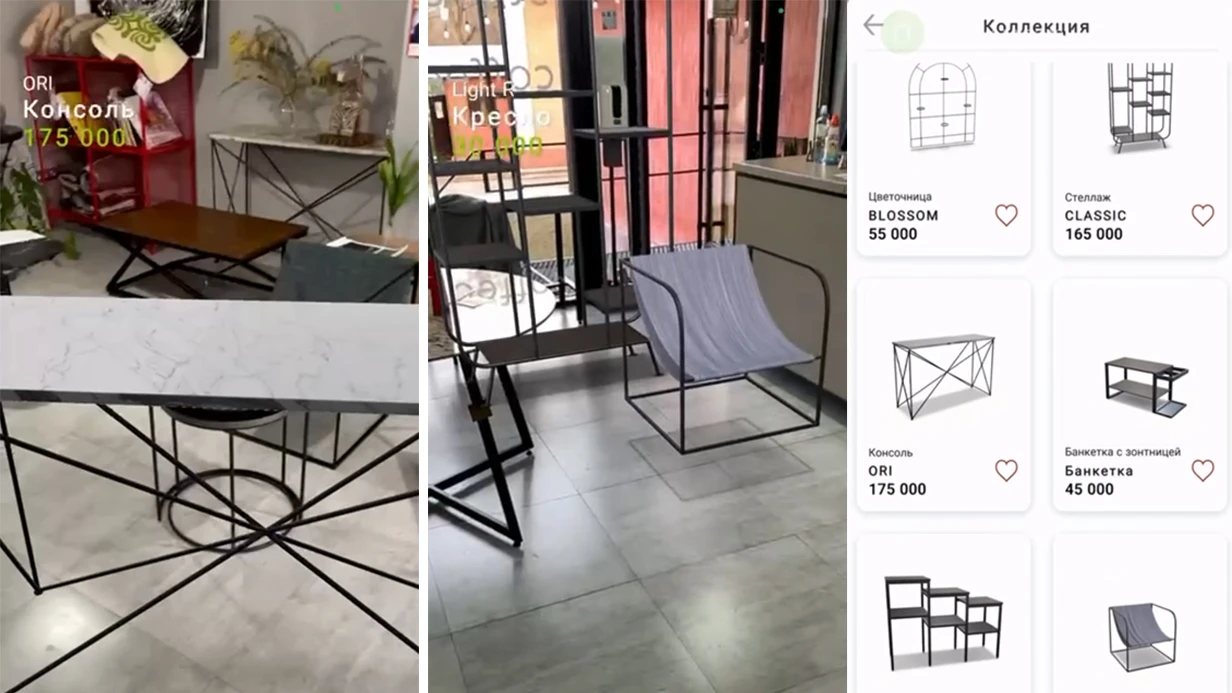
Interior visualization and online furniture try-on solve this problem. Through a smartphone camera or in a virtual room, the customer places the items they like in their own space, changes colors, and evaluates combinations.
Choosing furniture stops being abstract — a person sees their own room, their own light, and their own proportions, and confidence in the decision grows many times over.
The technology is available right now, and it can be integrated into your website or mobile app. It restores customer trust, shortens the purchase cycle, and increases conversion for a furniture store.
Wedevelop such VR/AR solutions on Unity — from a simple single-item try-on to a full-fledged virtual showroom. Take a demo and see for yourself.
How VR/AR applications for furniture boost sales and loyalty
A furniture buyer always hesitates: will the sofa fit by size, does the front match the wallpaper, won't the wardrobe be too bulky. These doubts drag out the decision, lower conversion, and lead to returns.
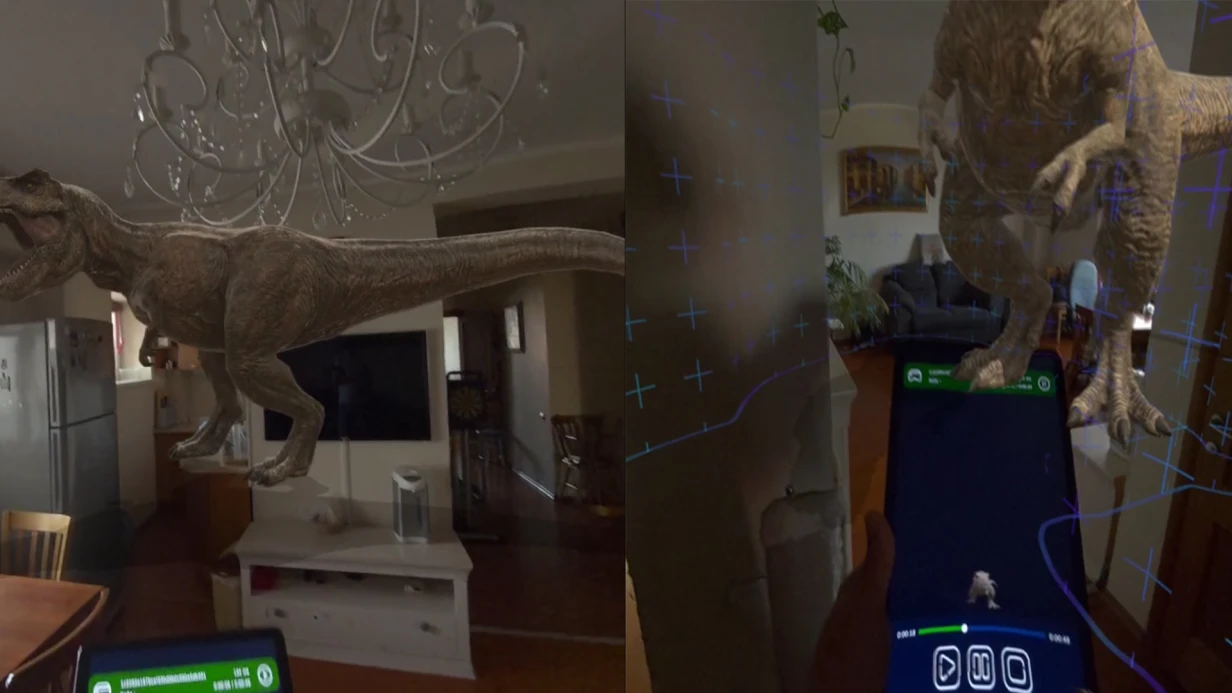
An AR application solves the problem: the customer "places" the model they like in their room via the smartphone camera and immediately sees how it looks at real scale.
Virtual try-on turns choosing from a lottery into a deliberate decision — the visitor places an order faster, and long deliberation becomes a thing of the past.
Furniture returns are lost money on logistics and repackaging, plus a customer's ruined mood. When a person sees the item in their interior in advance, the likelihood of disappointment drops sharply.
AR for furniture works even before the purchase: the customer personally verifies the size, color, and proportions. As a result, returns happen rarely, and you save on processing such orders.
No less than sales, AR strengthens customer loyalty. Customers tell friends about a convenient application, share screenshots on social media, and come back to complete matching sets.
A brand that offers such a service is perceived as modern and caring — this drives recognition stronger than traditional advertising.
And when a VR showroom is added, visitors move through a virtual apartment and change the furnishings in real time, which increases time spent and depth of engagement.
We develop such solutions on the professional engine Unity — it guarantees smooth operation on smartphones and VR headsets. We design intuitive try-on scenarios and integrate the application with your catalog or website so customers use it without unnecessary steps.
If you want to increase sales and reduce returns — let's discuss your task and show you implementation examples.
VR/AR solution formats for your business
When a furniture business chooses a visualization format, it's easy to get lost in the options. Wehave completed dozens of projects and know: the main thing is not the technology, but the task it solves.
Some need to quickly show a sofa in the customer's room, others need to fully recreate a store for remote buyers.
| Format | Who it's for | What it gives the customer |
|---|---|---|
| AR catalog | Online stores, showrooms with delivery | The customer sees the sofa or wardrobe in their apartment before ordering — fewer returns and more confidence |
| VR showroom | Furniture factories, showrooms | A full-fledged virtual hall: fabric changes, module arrangement without a real warehouse |
| Mobile app | Retail chains, dealers | A consultant presents the catalog in 3D, the customer "assembles" a kitchen to their own size in a minute |
| Interactive catalog | Wholesale sales, B2B | A manager demonstrates an entire collection in 5 minutes — fast purchasing decisions |
The format is chosen based on the customer touchpoint. If it's an online storefront, an AR catalog is enough. If it's an offline showroom, a VR showroom enhances the impression and shortens consultation time.
Any of these formats runs on our team's proven tools — no experiments and with a clear launch timeline. We'll advise where to start so the first results appear quickly.
Development stages of a VR/AR application for your company
For a furniture company, a VR/AR application is a sales tool: the customer sees the sofa in their apartment and makes a decision faster. To ensure the result doesn't disappoint, we run the project in stages — with clear timelines and checkpoints. You always know which stage the project is at and what you'll get as an output.
-
Brief and goals. We analyze what task the application solves: increasing orders, reducing returns, or raising the average check. We set timelines and success criteria — the estimate and plan are agreed before work starts, with no surprises.
-
Analysis and prototype. We study your catalog and typical customer scenarios: which models and for which rooms to show in AR. We create a prototype — you see the application structure before development and can make changes while it's still cheap.
-
Interface design. We adapt your brand identity to a smartphone or VR headset screen. Checkpoint: you approve the look, product presentation, and navigation logic.
-
Development and build. We program the logic, connect the catalog, size and material settings, and order processing. A working version is handed to you for testing on real devices — so you see the result with your own hands.
-
Testing and debugging. We check performance across different phone models and VR equipment: whether furniture "sits" correctly in space and whether the controls are intuitive.
-
Launch and support. We publish the application and connect QR codes to your website and showroom. We don't disappear after launch: we update the catalog, add models, and improve conversion based on your data.
What you get after project delivery: application, training, and support
You receive not just project files, but a ready-to-use working tool that solves your business tasks from day one.
We structure the delivery so your team can use the application without involving external specialists — everything needed for launch and growth is already included in the final package.
Here's what's included in the project delivery:
- A built application, ready to install on your devices (tablets, smartphones, VR headsets) — you don't need to understand the technical details.
- Source code with a clear structure — if you decide to develop the product with your own team in the future, you'll have full access to the project's "engine."
- A complete documentation package: installation, configuration, and update instructions. Any employee will get familiar with the system in 30 minutes.
- Staff training: we conduct online sessions and record video instructions. Sales managers will be able to launch the application independently, add new furniture items, and change prices without a programmer's help.
- Warranty support: within the agreed period, we fix errors free of charge, assist with configuration, and answer your team's questions.
- Refinements based on test operation — within the first 30 days after delivery, we promptly make the adjustments your employees discover during real work.
Staff training follows a simple "shown — repeated — reinforced" scheme. Your managers will learn to work with the furniture catalog, display models in augmented reality, and quickly select options for customers. This directly affects service speed and the number of successful deals.
Technical support works on a single-window principle: you write to your usual messenger or email — we take the task into work and keep you informed until it's fully resolved.
If the application freezes at an important presentation or the catalog needs an urgent update, you always know who to contact during business hours with a guaranteed response time.
The warranty is our area of responsibility. We support the project after delivery and are invested in the application running stably and generating profit for you.
Over 10 years of work, we've developed a process that eliminates "you handed it over — and forgot" situations: you have a complete package, a trained team, and a contact for the responsible specialist.
Case study: how an AR catalog increased sales 2.5 times
A furniture buyer can't imagine how a new sofa will fit into their living room. They postpone the decision, visit showrooms, hesitate — and often go to a competitor or return the item after delivery. For a furniture company, this means lost sales and extra logistics costs.
We solved this pain point for the furniture factory "Uyutny Dom": we developed an AR catalog that brings products to life in the customer's interior.
Now the buyer points their smartphone camera at a room — and sees how the selected sofa or wardrobe looks at real scale, taking into account wall color and lighting.
The solution runs on professional equipment, so the image is stable and doesn't "drift" even on budget phones.
Implementing the AR application changed commercial indicators.
In the first months, order conversion grew 2.5 times, the average check increased by 30% — customers became more confident in choosing more expensive models, and returns due to "not matching expectations" halved.
Reach also grew: customers share videos of virtual furniture on social media, bringing the brand free extra attention.
"We expected it would be interesting, but didn't think AR would become our main sales tool. Managers themselves offer the app to customers, and they come back again — this time for a kitchen and bedroom. It paid off faster than we planned," noted the factory's commercial director.
This case is not about technology but about the result. If your customers hesitate before buying, an AR catalog will remove objections and push them toward an order.
Tell us about your assortment — we'll advise how to turn your customer's smartphone into an additional catalog and increase sales.
How to choose the right VR/AR format for your task?
There is no universal answer like "VR is better than AR" — the right format is determined by your business model and the task you're solving.
Virtual reality fully immerses the customer in a digital space, while augmented reality overlays virtual objects onto the real world through a smartphone or tablet screen.
The difference is fundamental: VR is useful where a complete environment replacement is needed, AR is useful where anchoring to reality matters.
For a furniture store with a large showroom area or catalog, AR becomes an indispensable sales tool.
The customer points the camera at an empty corner of a room, sees a sofa at 1:1 scale, evaluates how it matches the wallpaper and room size — and makes a decision without the risk of a mistake.
This directly reduces returns because the buyer sees the product in their own conditions before the purchase, not after delivery.
For furniture manufacturers and factories, VR opens other opportunities — demonstrating new collections even before production starts.
You show dealers and wholesale buyers a finished lineup at a virtual exhibition, collect orders before the factory starts, and minimize prototyping costs. It's also a tool for staff training and for approving design projects with architects without logistical complications.
To choose between the formats, answer three questions. First: where does the customer make the decision — in your showroom or at home? Second: what object are you showing — an existing item in stock or a future collection that doesn't exist yet?
Third: what matters more — "trying on" an item in their own interior or "moving" a person into a fully modeled space?
If the buyer needs to match furniture with their real apartment — choose AR. If you need to show a concept that doesn't exist yet or create a sense of presence — choose VR.
In our projects, we often combine both formats: AR for catalogs and retail sales, VR for exhibitions and B2B negotiations. We'll analyze your task free of charge and recommend the format that will pay off faster — just leave a request for a consultation.
Frequently asked questions about VR/AR application development for business
Before ordering a VR/AR application, furniture companies have the same doubts: how much does it cost, when will we launch, which phones will it work on, and what happens after release.
We've put together short answers to these questions — without technical complexity or hidden conditions. If your scenario isn't in the list, write to us — we'll respond within an hour.
How much does it cost to develop an application for a furniture business?
The cost depends on scope: a simple AR catalog for 10–20 items is one thing, an interactive configurator with furniture arrangement in a room is another. At the start, we assess the project free of charge based on the brief and quote an exact price before the contract is signed.
The estimate includes all work: prototype, design, programming, and publication in app stores — no additional costs will appear.
What are the launch timelines?
A typical project takes 2 to 8 weeks depending on complexity. First, we conduct a short brief, draw up a prototype, and get your approval — this takes a couple of days. Then we build the application and test it on real devices.
If you need an accelerated launch for an exhibition or sale — we'll discuss a priority schedule, but quality won't suffer.
Which devices will AR work on?
AR mode works on modern smartphones with iOS and Android without special equipment — the customer points the camera at the catalog and sees furniture in their room. We test the application on popular models and adapt it for weaker phones. For virtual reality, we select common headsets and configure the system for them.
Do you provide a warranty and support?
After launch, the application remains under our maintenance: we fix errors, update it for new mobile OS versions, and monitor stability. The warranty lasts at least six months, after which you can extend support.
We train your staff to upload new products and change prices in the admin panel — without contacting a developer.
Leave a request for development and get a commercial proposal
Leave a request — and within a few days you'll receive a concrete plan for turning your idea into a working VR/AR tool for selling furniture. You don't need to understand technology: we take on the analysis, calculation, and launch preparation.
After your inquiry, we'll prepare for you:
- An analysis of your task and audience — which VR/AR formats will actually influence furniture choices and order growth;
- A concept and prototype — you'll see how a customer will interact with the catalog, not abstract descriptions;
- A detailed work plan with stages and timelines — clear on what happens from start to launch;
- A transparent estimate with a fixed cost — the cost is calculated after audit, with no hidden charges after the project begins;
- A delivery schedule — dates for key results so you can control the process;
- Recommendations for further growth — how to scale the solution after the first sales.
We discuss each item on a short call so the commercial proposal reflects exactly your tasks. Clarifying questions will take no more than 15–20 minutes, and you'll get full clarity on the budget, timelines, and business benefit.
Leave a request for development right now — it's not binding, but it gives you a precise roadmap. Contact us in your preferred messenger, and we'll respond within one business day.