

Why Law Enforcement Agencies Lose Time on Routine Operations
Law enforcement officers spend hours every day on repetitive checks: cross-referencing data, inspecting facilities, and filling out the same documents across different systems. Each such operation takes minutes, but on an agency scale it adds up to lost days.
The cause is the lack of spatial interfaces that overlay digital information directly onto the real environment.
Manual checks not only slow down work but also breed errors: a missed detail, a wrong entry, mismatched data.
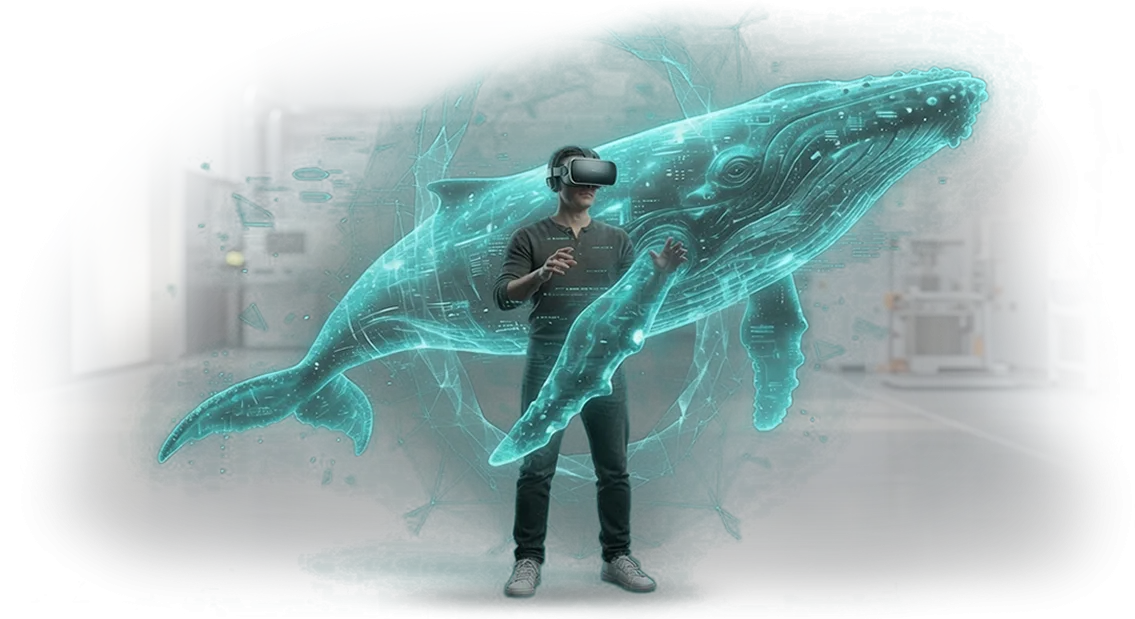
Digitalization of agencies increasingly relies on AR for law enforcement, because spatial applications for police put the needed information right in the officer's field of view and eliminate endless switching between reports and reality.
Imagine: an officer arrives at a facility and sees markers, a floor plan, a history of previous visits, and colleagues' comments — without paper protocols. There is no need to keep dozens of regulations in mind, so decisions are made faster and more accurately.
That is exactly how time losses on inspections are eliminated — through a properly designed spatial interface.
We help agencies move from flat screens to spatial applications, including for Apple Vision Pro and professional AR headsets. Our solutions adapt to the client's regulations, do not disrupt the established workflow, and undergo pilot testing on real tasks.
As a result, routine work speeds up, and officers stay focused on what matters most — protecting law and order.
What Tasks Spatial Applications Solve for Agencies
Agency leaders make decisions every day that affect people's lives and the safety of entire regions. Information comes from many sources: reports, maps, photos, and videos — and it needs to be processed quickly.
Spatial applications gather data into a single three-dimensional picture, letting leaders see the full situation and act proactively.
Response Speed
When every minute counts, it is critical to assess the situation instantly. A spatial interface displays a building plan, terrain, or patrol route in real time.
The leader sees where officers are, which zones are covered, and where backup is needed — and issues orders faster than when working with paper maps.
Data Visualization
A three-dimensional model of an incident or facility replaces dozens of pages of reports and flat diagrams. An officer can "walk through" a virtual copy of a building, examine it from all sides, and identify vulnerable spots in advance.
This clarity reduces the risk of errors and helps make the right decisions even in unfamiliar environments.
Safety and Control
Remote access to spatial data makes it possible to keep dangerous operations under control without putting people at risk. For example, a drone-based area inspection or a virtual facility check before a team is deployed. The leader monitors the process in real time and can adjust subordinates' actions at any moment.
Training Cost Savings
Training officers is expensive, especially when it comes to emergency response. Spatial simulators make it possible to practice scenarios repeatedly, without risk or resource expenditure.
New officers acquire skills faster, and experienced teams stay sharp without constant trips to the training ground.
Such solutions are already in use at agencies. They save time and money and, most importantly, help save lives — that is why spatial interfaces are becoming the standard for leaders who value efficiency.
VR/AR/MR Application Formats for Law Enforcement
An officer must act confidently in situations where a mistake is costly. Traditional lectures and video materials do not provide the needed practice, while trips to a training ground take time and resources.
Spatial applications close these gaps: they immerse users in an environment close to reality and let them practice actions without risk. What matters is that the result is measured not by equipment specifications but by the unit's readiness for complex situations.
We use three main formats — depending on the agency's task, each delivers a different effect.
| Format | For Whom | What It Delivers to the Client |
|---|---|---|
| VR simulators for police | Training centers, internal affairs units | Skill practice in a safe environment: the officer sees the consequences of decisions, the instructor sees an objective picture of actions |
| AR applications for investigation | Investigators, forensic experts | Overlaying virtual data onto the crime scene — faster scene documentation and clear reconstruction for court |
| MR applications on Apple Vision Pro for agencies | Leadership, operations headquarters | Collaborative operation planning: 3D maps, diagrams, and data available to all participants simultaneously |
VR/AR formats for the Ministry of Internal Affairs can be used separately or in combination, when one tool complements another.
This approach is already used in training centers and investigation departments: instead of lengthy material preparation, the agency gets a working tool that reduces training time and improves decision quality. Tell us about your task — we will select a format and show how it will fit into your work.
How the Development of a Spatial Application for Your Task Works
Developing a spatial application for law enforcement is a process where both technology and discipline matter. We run the project from brief to deployment so that you always understand what is happening and what you are paying for.
Stages of AR Project Development
-
Brief and scenario research. You describe how your officers work: training, scene examination, working with testimonies, or operational inspection. We clarify what tasks the application should cover and form the requirements.
-
Plan and prototype. We show the interaction logic, screens, and scenarios in a mockup. Project approval at this stage takes minimal time because you see the result before full-scale development begins.
-
Interface design. A spatial application should be controlled by gestures and gaze and be understandable without instructions. We think through every officer action to eliminate errors during rapid use.
-
Implementation and testing. We build the application on proven technologies and test it on real devices and in conditions close to yours. You receive intermediate versions and make edits along the way.
-
Pilot operation. Together with your users, we launch a pilot mode, collect feedback, and adjust scenarios. This reduces risks during full-scale deployment of spatial applications.
-
Deployment and support. We roll out the solution within your infrastructure, train your staff, and remain on support. We continue refining the product for new tasks and equipment updates.
What the Application Delivery Includes for the Client
The client receives not just an application but a complete, ready-to-operate package — from working scenarios to training and support. We understand the requirements of government clients: documentation, regulations, staff training, and maintenance.
That is why the application delivery is structured as a full package that the unit can use immediately after acceptance, without bringing in outside developers.
The delivery includes:
- The application deployed on Vision Pro devices and configured for the unit's tasks — from drills to daily operational work.
- Source materials and usage rights: a library of 3D scenes, scenarios, algorithms, and reference data for independently updating content.
- Technical and operational documentation for the government client: composition description, operating instructions, update procedures, backup and recovery regulations.
- Staff training: hands-on sessions for operators, administrators, and future instructors who can pass skills on to colleagues within the agency.
- Application support for the entire contract term: scheduled updates, troubleshooting, and consultations on expanding functionality for new tasks.
- Action logging and access control — built-in monitoring tools required for operation in secured government networks.
We make sure every delivery item is accepted without remarks: we help prepare acceptance documents, conduct demonstrations on real scenarios, and train staff to a confident level of use.
In the end, the client gets a working system that can be applied immediately, plus a complete documentation base for lawful operation and future development.
Case Study: Apple Vision Pro Application Accelerated Investigation Work
The AR case for investigation began with a task set by the head of an investigation department: reduce crime scene examination time and lower the number of errors when documenting evidence.
Field teams spent hours on manual measurements, photography, and filling out paper reports. Any inaccuracy meant another site visit and delayed the investigation.
We proposed a solution based on Apple Vision Pro that moves the process into a digital environment without losing context.
How It Works in Practice
An investigator puts on the headset and sees the real environment with overlaid digital markings: distances, angles, key objects, and comments.
There is no need to switch between camera, tape measure, and notebook — all data is automatically tied to a spatial diagram and saved in a single structure. This work takes half the time and does not require repeat visits to clarify details.
Implementation Results
After deployment in one department, we recorded concrete changes: examination duration dropped by roughly 40%, and the number of errors in primary documents fell by half.
The application is especially useful at complex crime scenes where multiple specialists previously had to be brought in for measurements and documentation.
This case confirms: Apple Vision Pro in the public sector is not an experimental gadget but a working tool for speeding up processes.
The client has already requested expanded functionality for new scenarios, and we received a follow-up project — the strongest indicator of the solution's value for the law enforcement field.
How to Choose the Right Format for Your Unit?
The answer depends not on technology trends but on the operational task you are solving.
A patrol officer who needs to see alerts without breaking focus from the environment needs one format; a training simulator for assault drills needs another; remote crime scene inspection needs a third.
So the first step is to define what exactly should change in your unit's work: preparation speed, action accuracy, risk reduction, or time savings.
Three criteria are decisive: who will be the user (operative, investigator, checkpoint officer), in what environment the work happens (street, building, mobile post), and what constraints exist — for example, the need to work in gloves, at night, or in tight spaces.
It is these non-standard requirements, not a "pretty picture," that determine whether you need full virtual simulation, real-world data overlay, or a mixed scenario. A good contractor will first ask you about these conditions and only then propose a solution.
When choosing a vendor, pay attention to how they validate the format in practice. Ask whether they test with real officers, adapt the interface to your regulations, and how they protect sensitive data.
Be wary if you are immediately shown a ready-made "universal" product without clarifying details. Security in your field is not just a technical setting but a guarantee that information will not leave the unit and the system will not fail at a critical moment.
Come to us with a description of your task — even if it seems unusual. We will analyze use cases together, determine the format, and design a solution that officers will actually use, not one that gathers dust after a pilot launch.
You will get not just an "application" but a tool that solves a specific problem for your unit.
Frequently Asked Questions from Clients About Development for Government Agencies
For government agencies, data security and compatibility with existing systems are critical. We answer the main client questions: information protection, integration, equipment, and timelines.
How protected is the data when using the application?
We design the architecture so that data stays within your agency's secured environment: we use encryption, role-based access control, and the option of local deployment without transferring information to external networks. You get full control over data and compliance with internal regulations.
How will the application integrate into our existing system?
We use standard data exchange protocols, so the solution is compatible with most internal databases and record-keeping systems. At the start, we study your infrastructure and propose an integration scheme without stopping current processes. You will not have to change familiar tools — the AR/VR application becomes their extension.
What equipment do we need to purchase?
We select professional devices based on the task: virtual reality headsets, including Apple Vision Pro, or AR headsets suited to your environment.
We help choose a package within your budget and requirements, configure the equipment, and train your staff — you get a turnkey solution without extra technical hassle.
What timelines and guarantees do you provide?
We fix timelines in the contract after the technical specification is approved: a prototype in 2–3 weeks, deployment in 1 to 3 months depending on scale.
We provide a warranty on application performance and stay in touch after launch: we update, support, and assist with operation. You get a predictable process and protection from unexpected delays.
Let's Discuss Your Task and Calculate the Project Cost
For law enforcement agencies, Vision Pro applications are not a PR experiment but a working tool — from training to on-site navigation at a crime scene.
But before ordering development, it is important to understand which scenarios will solve your task and how they will fit into regulations. That is why we start with a consultation, not a mockup.
At the meeting, an engineer will break down your task, propose solutions, and prepare a project cost estimate — with timelines, stages, and budget. This is free and non-binding.
From there, it is your call: if the project fits, we move to a pilot deployment on a small scale to verify the value in real conditions.
What you get when you contact us:
- Engineer consultation — we discuss goals, users, and constraints.
- Project cost estimate — timelines, stages, and budget with no hidden items.
- Technical audit of your infrastructure — what is needed for uninterrupted operation.
- Prototype on your data — you see the result before full-scale development.
- Pilot deployment — we test the solution with a pilot group of officers.
- Training and instructions — so the team quickly masters the tool.
- Post-launch support — assistance and refinements based on operational results.
This takes one call, and afterward you will understand what result you will get and how we will achieve it. Submit a request — we will send the cost estimate and a plan of first steps. We will help you go from consultation to pilot deployment.