

Product Presentation in WebAR — How to Keep a Client from the First Screen
Most companies lose a potential customer on the first screen: static slides, long descriptions, and slow loading drive them to a competitor.
Buyer attention is becoming a scarce resource — you have a few seconds to spark interest, but not enough time to explain all the product's benefits.
A WebAR presentation solves this problem by turning product discovery into an interactive format. The customer sees the product in 3D, can rotate it, examine details, change color or configuration — all directly in the browser, without installing apps or registering.
This approach turns passive viewing into active engagement: attention retention increases multiple times, and the product exploration process becomes an engaging experience.
An interactive presentation directly affects customer engagement: they don't just look at the screen — they participate in choosing, try the product against their own tasks, and readily share their impressions with colleagues.
This increases brand recall, shortens the path to purchase, and generates more quality inquiries than traditional catalogs and PDF files.
For several years we have been creating WebAR presentations for companies across various industries — from technology to real estate. We use professional equipment and proven tools, so the result is always consistent: fast loading, adaptation to any screen, and ease of use.
You get a tool that works for the customer and delivers measurable value — increased product interest and conversions.
Benefits of WebAR for Business: Engagement, Reach, Leads
An ordinary product presentation is slides that a customer skips through in seconds. Augmented reality changes the mechanics: instead of a passive narrative, a person sees the product in their own space, explores details, changes color or configuration. They don't just look — they interact, and this directly influences the purchase decision.
What you get from a WebAR product presentation:
- Engagement. The product is examined for 1–2 minutes instead of 10 seconds on a slide. Prolonged contact increases brand memory and trust.
- Reach. A participant sends the link to the AR experience to friends and colleagues. Each one brings another 2–3 viewers — reach grows without advertising spend.
- Recognition. The unusual format sets you apart from competitors, and social media posts strengthen the association with a modern tech company.
- Lead generation. A request form or a “get a consultation” button is placed inside the AR scenario. An interested user leaves contacts without leaving augmented reality.
- Conversion growth. WebAR replaces static catalogs and presentations: the buyer immediately sees the product “in real life,” so the share of inquiries and repeat views increases.
To achieve this effect, you don't need a complex product. Our team uses professional development tools and creates a WebAR scenario for your task: from a simple 3D model to an interactive showroom with forms.
Launch takes a few weeks, and clients get stable performance on any modern smartphone and support after release.
Product Presentation Formats for Your Task
WebAR presentations work in a smartphone browser — no app installation or complex setup required. But a format that showcases a product effectively at an exhibition is not always suitable for an online storefront.
For a presentation to sell, it's important to choose the right scenario for the specific task: hold attention at the booth, let the product be examined in detail, or guide the customer to an online purchase.
We adapt WebAR to your scenario — from offline events to digital campaigns. Here are the typical formats we use in projects:
| Format | For whom | What it gives the customer |
|---|---|---|
| Marker-based presentation on a poster or packaging | Offline stands, exhibitions, promos | The visitor points the camera at the poster and sees a 3D model of the product — this attracts attention, keeps them at the booth, and prompts a conversation with a manager |
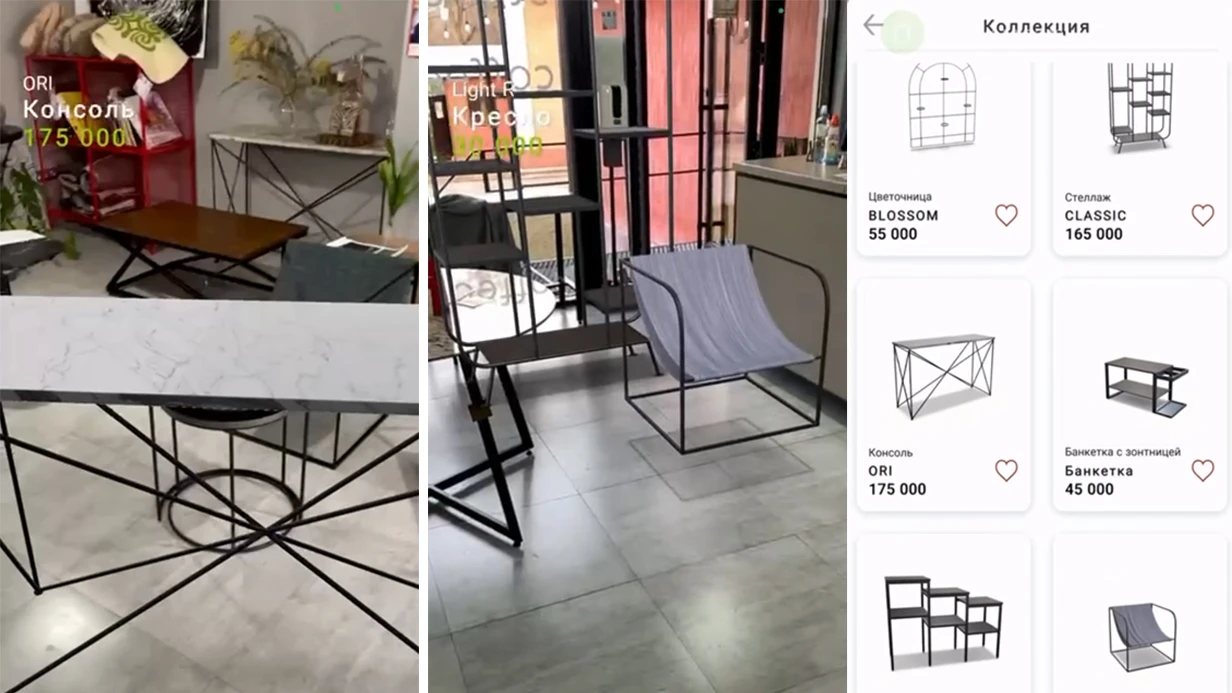
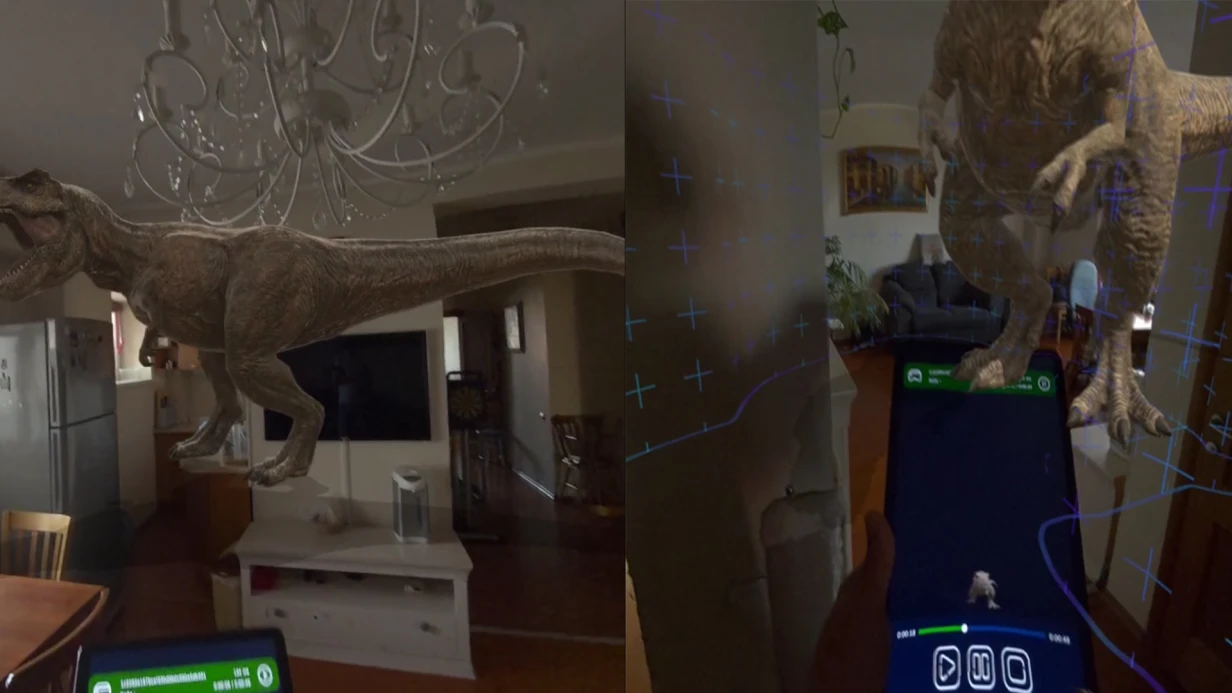
| Spatial markerless model | Showrooms, storefronts, partner presentations | The product can be placed on a table or “in the air,” viewed from all sides, with colors and configurations changed — making it easier to show real scale and details |
| Online storefront with QR code | Online stores, social media, email campaigns | The customer opens the link and “places” the product next to themselves or in their room. This increases purchase confidence and reduces returns |
| Interactive catalog with model switching | Sales managers, B2B negotiations | Multiple product variations are visible on one screen, allowing quick comparison of options and selection of the right solution for the client — no paper brochures needed |
All formats launch via a link or QR code — the visitor doesn't download apps or waste time registering. We will select the appropriate scenario, prepare content, and test on real devices so that the presentation works equally well at an exhibition and in an advertising campaign.
Stages of Launching a WebAR Presentation: From Brief to Report
Building a WebAR presentation without chaos or missed deadlines is possible if the process is set up like a conveyor belt.
We handle all stages — from the initial brief to the post-launch report — and you always understand what's happening with the project and when the result will be ready.
We divide the work into short steps with clear checkpoints. This removes the risk of “let's redo everything on the last day” and allows the presentation to launch exactly in time for your event or advertising campaign.
- Brief and goal. We define exactly what the presentation shows: the entire product, details, or a process. We determine the audience and scenario — where the visitor will see AR, what they should remember, and what action to take.
- Planning and estimate. We put together the concept, timeline, and scope of work. You receive a transparent plan with a fixed cost and dates. At this stage, it's clear what's included in the project and what can be added optionally.
- Layout approval. We prepare the visual concept and storyboard. You see what each screen and scene will look like before we start development — edits at this stage cost almost nothing.
- Implementation. We build a working version on a professional engine and test it on real devices so that the presentation runs stably for most users without installing applications.
- Launch. We publish the project on your domain via a short link. Visitors scan the QR code and immediately enter AR — no registration, downloads, or extra steps. Nothing is blocked or lags on the spot.
- Analytics and support. We track how many people opened the presentation and how long they interacted with the product. After launch, we stay in touch: we fix details, add new scenarios, and make sure everything works.
The result is a manageable project with a predictable outcome. You don't have to chase the contractor or wait to see “how it goes” — you get a ready-made presentation that generates leads and increases brand recognition.
Delivery Package: What's Included in WebAR Development
After project completion, you receive not just a working WebAR presentation but a complete package that lets you manage the feature without intermediaries and quickly adapt it to new tasks.
We hand over all materials, instructions, and training — so you don't depend on the contractor and can make changes as your business grows.
- Working WebAR presentation — launch via QR code or link from any smartphone, no app installation required. Visitors reach your product in one click, and you get a ready-made tool for presentations and exhibitions.
- Source materials — 3D models, graphics, and video used in the project. You can update them for new promotions, seasonal offers, or rebranding without rebuilding the project from scratch.
- WebAR documentation — clear instructions for launching, configuring, and transferring to your domain. Even an employee without technical experience can figure it out in one day and manage the page independently.
- Staff training — a short session for your team: how to update content, track statistics, and prepare reports for management. No “secret knowledge,” all processes are transparent.
- Usage reports — analytics on the number of launches, average interaction time, and user geography. This data helps evaluate the presentation's effectiveness and plan the advertising budget.
- Technical support for 30 days — quick answers to questions, resolution of possible issues, and help with content updates after release. You are not left alone with the product at the most critical moment.
In the end, you get not just a “ready page” but a standalone tool that your team can develop without developers' help. This reduces costs and speeds up the launch of new promotions — meaning it benefits your business faster.
Case Study: How We Increased Conversion with WebAR
For one of our clients — a home goods retail chain <cite>DomProfi</cite> — we developed a WebAR presentation instead of a regular catalog.
Customers couldn't “try on” appliances for their kitchen and kept postponing their decision, while managers had to explain sizes and materials over the phone. This reduced conversion and overloaded the sales department.
We proposed a simple scenario: the customer points their smartphone camera at a QR code in the store or on the website, and the desired model appears right in their kitchen.
The user can move, rotate, and change the color of the product themselves — no app installation or registration required. This removes the main fear: “will it fit in my interior?”
Business Results
The campaign lasted two months, and the client saw measurable changes. Conversion to inquiries increased by 68% compared with the regular catalog. Average time on the page grew from 40 seconds to almost three minutes — customers studied the product in detail and returned to it.
At the same time, recognition increased: a fifth of visitors saved or forwarded the link to the 3D view, which provided additional reach without an advertising budget.
What This Means for the Business Owner
The implementation paid off within the first month: the number of website inquiries grew by 1.7 times, and the load on managers decreased — no need to explain basic features because the customer has already “seen” the product at home.
After the test, the client expanded WebAR to all new models and placed a repeat order for the next season.
If you want the same clear and measurable result — we'll start with a short brief, show implementation examples, and calculate how many additional inquiries your presentation will bring.
What If I Have Specific Requirements for the Presentation?
This is the most common question, and the concern is understandable: it seems that a ready-made platform only suits typical scenarios, while your product or event is unique.
Specific requirements are not a problem — they are an ordinary working task, for which we design the logic and mechanics from scratch.
We don't fit the project to a template — on the contrary, we adapt WebAR to your scenario.
Whether you're showcasing a product with a complex shape that doesn't come alive in a standard camera, or you need to gather an audience at a specific location and hold their attention for 10 minutes, we design the interaction around your task.
At the same time, you don't lose speed or convenience: all the mechanics can be reused and updated without major investment.
The key advantage is flexibility without losing performance. You get not a “box,” but a mechanism assembled for your product: any format, non-standard display logic, integration with your materials and brand style.
If needed, you can change content yourself — your team can manage the presentation without an in-house developer, and we will ensure smooth operation on a professional stack.
Send us a description of your specific task — we'll show how it can be solved through WebAR with maximum benefit for your scenario.
Common Doubts: Answering Questions About WebAR
Before launching WebAR, clients always have questions: will the technology scare visitors, will it seem complicated, will it justify the budget. Below, we address the most common doubts — briefly and to the point.
Won't visitors be confused about how to use it?
Nothing needs to be installed: a person opens a link or points the camera at a QR code — and a 3D object appears on the screen. We add a hint on the first screen, so the scenario is clear even to those experiencing augmented reality for the first time.
What if someone has an older/slow phone?
WebAR works directly in the browser and does not require high device performance. We adapt the project for most modern smartphones and test it on typical models before launch.
If the camera is not supported, the visitor will see a fallback option — a video or a model without augmented reality.
How much does it cost and when will it pay off?
The WebAR budget is comparable to a good commercial, but you get an interactive experience that engages more strongly. We measure payback through concrete metrics: how many visitors opened it, how much time they spent, and how many left an inquiry.
In a typical advertising campaign, that means thousands of interactions — a measurable result visible in the report.
Is it safe for users and the company?
Yes. WebAR works over a secure browser connection, and we do not collect data without a person's consent. The camera is used only for object overlay and does not transmit images to the server. For businesses, this is a controlled and safe format.
Order a WebAR Presentation Today
Leave a request for development — and within the next few hours we'll contact you to clarify the details. You don't need to understand technical nuances: we'll ask the right questions, help you define the task, and propose a solution for your specific needs.
Immediately after submitting your request, you receive a clear action plan — no bureaucracy or lengthy approvals. We value your time and start the work as quickly as possible.
What happens after you submit your request:
- Confirmation and initial conversation — within one business day, a manager contacts you to discuss the presentation's goals and target audience.
- Free consultation — we help determine which WebAR scenario suits your product best: a 3D model, an interactive instruction, or a virtual try-on.
- Preliminary plan and timeline — you receive an estimate of the scope of work, stages, and launch date, so you can fit the project into your marketing calendar.
- Scenario and visual style approval — you see what the presentation will look like before development begins and make edits without additional costs.
- Development start — the team begins work, and you get access to a demo version already at the early stages.
- Launch and support — after project delivery, we stay in touch and help integrate it into your website or application.
You can start your WebAR project as early as this week — we process requests daily. To get a consultation and discuss your task, just leave your contact details in the form below.
We'll call you back, answer your questions, and propose a solution that will bring real value to your business.