

Why aviation training requires VR/AR/MR solutions
Traditional aviation training today hits two barriers: high cost and risk. Every flight hour on a training aircraft means fuel, depreciation, and insurance load, and a cadet's mistake in a real cockpit can cost lives.
That is why aviation training has historically been accessible only to a narrow circle of specialists, and practicing rare emergency scenarios was literally "by hand," with no way to safely try and make mistakes.
Stationary simulators partially cover the need, but they are tied to infrastructure, require maintenance, and cost as much as a small aircraft.
As a result, a training center cannot quickly scale the program, and a cadet gets a limited set of scenarios far from the real diversity of situations.
Immersive technologies remove these limitations: virtual reality makes it possible to reproduce any scenario — from a routine flight to engine failure or severe weather conditions — in a safe environment and without consuming equipment life.
For the customer, this means a shift from "expensive, rare, dangerous" to "cheap, frequent, safe." Pilots and engineers can train as much as needed, repeat complex elements dozens of times, and the system objectively records every action and shows growth areas.
This approach accelerates training, improves its quality, and at the same time reduces the overall cost of instruction.
Beyond savings, virtual reality solves the safety issue on the ground: ground personnel, refuelers, ground handling staff — everyone who works near aircraft — can practice procedures and abnormal situations without creating a threat to themselves or the crew.
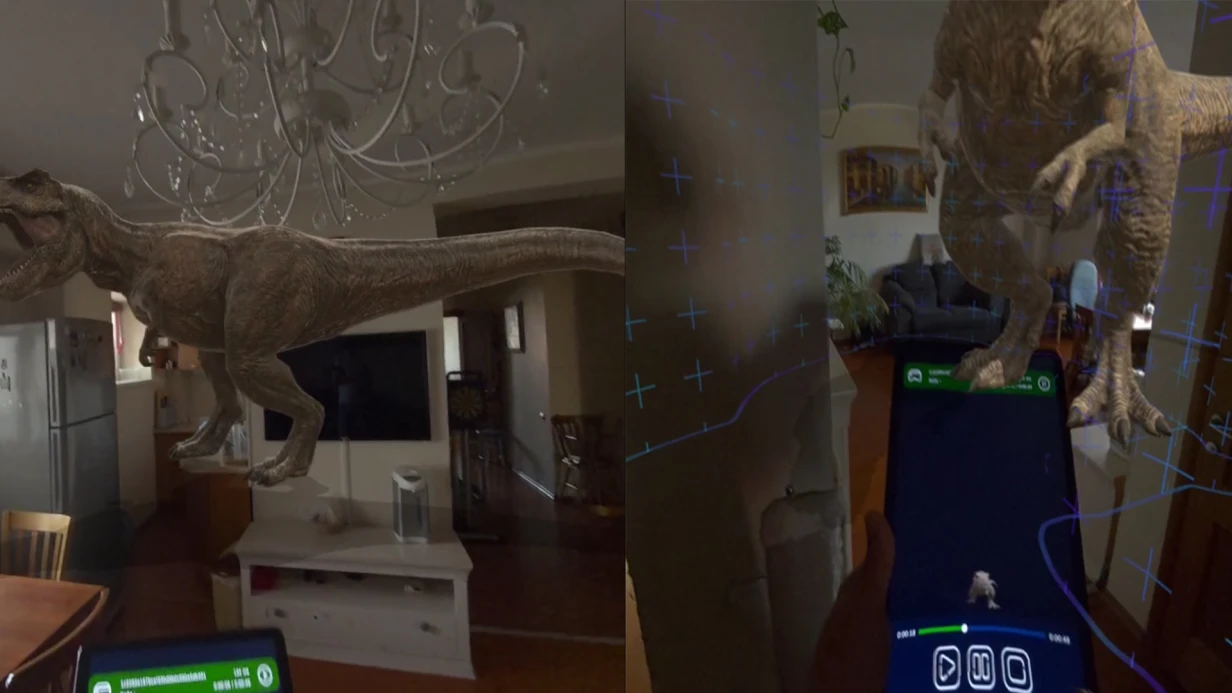
That is why aviation training is increasingly built around mixed reality, where virtual objects are overlaid onto real equipment.
We help airlines and training centers implement such solutions: we design scenarios, link them to your regulations, and deliver turnkey programs. Implementation takes weeks, not years, and does not require pauses in operations.
As a result, you get a predictable level of staff training, reduced spending, and, most importantly, confidence that every employee acts correctly even in the most critical situations.
Five key benefits of implementing immersive technologies
Traditional aviation personnel training requires expensive simulators, fuel consumption, and instructor time. Immersive learning based on virtual simulators changes the economics of the process while maintaining and even improving training quality.
-
Improved performance. The virtual environment allows practicing actions repeatedly, with instant feedback. Cadets memorize procedures faster and make fewer mistakes in real flights.
-
Lower costs. Virtual simulators do not require fuel, aircraft maintenance, or airfield rental. The main expenses are scenario development and equipment, which pay for themselves through reduced flight hours.
-
Risk-free practice. Emergency situations — engine failure, fire, severe weather — can be practiced without threat to life or equipment. This is the only way to gain experience in conditions that cannot be safely created in reality.
-
Simulating rare scenarios. Immersive training allows reproducing any abnormal situation, including combinations of multiple failures. The team trains to act cohesively without waiting for such an event to occur in a real flight.
-
Flexibility and scaling. Training takes place anywhere and is not tied to the fleet schedule. One scenario can be used for hundreds of employees, and changes are made within days.
We use professional development tools, such as Unreal Engine, to ensure the realism and stability of virtual simulators. This gives the customer a predictable result and confidence in training quality.
VR/AR-MR solution formats for aviation training tasks
Aviation training is different tasks: from studying the cockpit to practicing abnormal situations. Each task needs its own format: a quick hint will not replace full immersion, and a complex simulator is excessive where a reference guide is enough. That is why we offer three levels of immersion — from AR instructions to VR and MR.
| Format | Purpose | What it brings to training |
|---|---|---|
| AR instructions | Pre-flight inspection, maintenance, work with schematics | Fast on-the-job learning, fewer errors |
| VR simulators | Practicing procedures and emergency situations | Actions honed to automation without risk or fuel consumption |
| MR mixed reality | Working on a real simulator with digital scenarios | Flexible exercises without reconfiguring equipment |
The choice of format affects cost and training timelines. AR instructions are the fastest to implement and suit mass staff training. VR simulators provide maximum immersion for complex procedures.
MR combines practice on real equipment with digital prompts — convenient for practicing joint crew actions.
We help you choose the format at the start: we audit tasks, calculate instructor workload, and propose an implementation plan. All solutions can work in a web version — students do not need to install complex software, just a device with a browser.
Stages of creating a turnkey VR/AR application
Any VR project starts with scattered ideas and ends with a working tool that people use every day. For an aviation training application to truly solve real tasks — from practicing abnormal procedures to crew training — a transparent process is needed.
We have broken the work into stages: you always understand what is happening, what you are paying for, and what you will receive at the end.
- Brief and task immersion. We meet, listen, and ask questions: which skills to practice, for which audience, which scenarios are critical. We record goals and acceptance criteria — so there are no expectation gaps.
- Concept and approval. We propose the simulator structure, scenario set, and interaction logic. Everything is approved before development — so you avoid unexpected revisions at late stages.
- Working prototype. We create a basic version that can be opened in a browser and "touched." You see how the cockpit looks, how elements react, and make changes while it is still inexpensive.
- Development and content. We implement full functionality: training scenarios, hints, feedback on actions. We show results every 1-2 weeks — you control the progress.
- Testing with the target audience. We involve instructors and pilots, collect feedback. We fix errors and refine scenarios so the application is comfortable for real users.
- Launch and training. We deploy the system, onboard employees, and train administrators. We run pilot sessions and support the first launches — without fuss or downtime.
- Support and development. We monitor operation, collect session statistics, and update scenarios to meet new requirements. You get not a one-time application but a working tool that lives alongside the business.
Each stage ends with documented intermediate results — you sign an acceptance certificate and know exactly what you received. If necessary, you can stop at any step without losing invested funds. This makes the process predictable and removes the main risks.
What is included in a VR/AR training system delivery
A complete aviation training package is a turnkey solution, not scattered files. We deliver everything needed for your instructors and cadets to start classes on day one: from software modules to staff training and regular updates.
- Software modules — refined scenarios: pre-flight preparation, response to abnormal situations, skill practice to automation. Modules easily adapt to your regulations and aircraft types.
- Documentation — a set of clear guides: installation and configuration, instructor instructions, student reference cards, maintenance procedures.
- Briefing — a personal introduction to the system for your specialists: we show how to launch the system, configure a workstation, and quickly resolve common issues.
- Staff training — hands-on training for instructors: how to conduct classes, track cadet progress, review errors, and generate performance reports.
- Updates — regular updates to scenarios and interface: the system does not become obsolete but continues to meet current training requirements and your internal changes.
The entire delivery is backed by service support during operation. You get a single working system that we continue to monitor after launch.
Case study: VR simulator for an aviation school — results
When an aviation school approached us, its management was looking for a way to accelerate cadet training for emergency response. Training on real aircraft is expensive and time-consuming — per shift, each cadet completes only a few approaches.
We proposed a WebVR-based virtual simulator: it works through a browser, does not require expensive flight simulators, and is easily deployed in a standard computer classroom.
In two months, 120 cadets completed training on the simulator. Time to practice each emergency scenario dropped by 40%, and the share of those passing the flight clearance exam rose by a third. The average exam score increased from 3.8 to 4.6 points.
The school's leadership sees the main result not in numbers but in the fact that a cadet acquires the required skill in one session instead of three training cycles.
The instructor can observe each cadet's actions in real time and correct mistakes immediately. This reduces the load on teachers and makes the training process transparent — it is always clear who has not practiced which procedures enough.
The simulator allows creating any abnormal situation, including engine failure, onboard fire, and emergency landing — things that are dangerous to model in real life.
After the pilot implementation, the school renewed the simulator license for two more semesters and ordered additional modules: landing gear failure practice and operations in severe weather conditions.
A repeat order and expanded functionality are the best confirmation that virtual training delivers measurable results and pays off the investment.
How to choose a VR/AR format for your training tasks?
Choosing a VR/AR format always comes from training tasks, implementation scale, and budget — not from technology trends.
In aviation training, the difference is especially noticeable: familiarizing cadets with the crew cockpit can be done in a lightweight web format, while practicing emergency procedures to automation requires full immersion and tactile feedback.
We help formulate selection criteria at the start so you do not overpay for complexity or end up with a solution that does not fit the training process.
If the goal is mass training and rapid coverage, the web format (WebVR) is optimal: cadets log in from their own devices, and you update materials centrally without additional equipment costs.
If high realism and muscle memory are needed, full VR simulators with professional peripherals in dedicated classrooms are worth considering. We will advise which level of immersion is justified for each discipline without requiring unnecessary investment.
Project scale affects the choice as much as budget. For a single department, one set with a few scenarios is enough, while a training center with several groups will need server architecture that can handle simultaneous sessions.
At this stage, it is important to estimate the number of users and launch frequency in advance — this determines both the format and the total cost of ownership. We help calculate overall costs, including content updates and technical support.
An additional factor is technical requirements: what equipment you already have, what level of IT support, and whether access is needed from tablets, laptops, or classroom workstations.
Based on this data, we propose three to four implementation options differing in budget and timelines. You make decisions based on clear metrics: launch speed, number of simultaneous learners, update complexity.
Ultimately, choosing a format is a compromise between the desired effect, available resources, and timelines. We make this compromise conscious and beneficial for you.
Frequently asked questions about implementing immersive training
Typical concerns relate to the complexity of integration, the need to purchase equipment, and result guarantees. We answer directly — without technical details.
How difficult is it to integrate VR into the training program?
There is no need to restructure the training process. VR modules complement existing classes: practicing emergency procedures, studying the cockpit, responding to abnormal situations. A pilot group is enough — we adapt scenarios to your regulations.
What equipment is required?
You will need standard VR headsets and a few computers with appropriate configuration — nothing unique. We will select a bundle for your budget and check compatibility with your facilities. Equipment can be rented for the duration of the pilot project.
What guarantees and support are provided?
We fix timelines and performance metrics in the contract. We conduct a test launch, train instructors, and stay in touch after implementation: we update scenarios and assist with technical issues. We have dozens of projects for aviation training centers and corporate clients.
Ask your question — we will prepare an implementation plan and calculate the equipment load. This is free and non-binding.Let's discuss your VR/AR project for aviation training
Aviation training requires precision: every skill must be practiced to automation. VR/AR allows immersing cadets in realistic scenarios without risk or unnecessary flight-time costs.
But for the solution to truly work, the task must be correctly formulated — and at this stage, dialogue is needed with those who understand both aviation and technology.
We work according to a transparent process. You submit a request — we contact you within one business day, get familiar with your tasks, and advise which VR/AR formats fit your training. The consultation is free and non-binding.
Here is how the process looks:
- You send a consultation request — a brief description of the task is enough.
- On a call, we clarify the audience, training scenarios, and success criteria.
- We prepare a preliminary cost and timeline estimate — usually within a few business days.
- If needed, we arrange a demonstration on your devices or with our equipment.
- We agree on the work plan and move to collaboration: contract, design, development, implementation.
- After launch, we stay in touch: update content, add scenarios, train instructors.
This way, you understand the budget, timelines, and scope before the project even starts. No hidden stages: every step is documented and approved by your side.
Start with a short request — it takes a couple of minutes. Tell us about your training program, and we will propose a solution that improves training efficiency and reduces simulator costs.