

Why the oil and gas industry loses money on training and downtime
Personnel training in the oil and gas industry relies on real equipment: expensive training complexes, site visits, and instruction with restricted access.
While an employee gains experience, they inevitably make mistakes — each one risks turning into an accident, injury, or downtime.
At the same time, the industry demands strict compliance with workplace safety standards, and the only way to verify a person's readiness for an emergency is in real conditions — with a high cost of error.
Emergency equipment downtime is the second problem that directly hits revenue. An hour of downtime at an oil pumping station or drilling rig costs an enormous amount, and eliminating the consequences drags on for days.
The causes are usually the same: incorrect personnel actions, an insufficiently practiced response algorithm, and a lack of skills for working under stress.
Training for this at a real facility is expensive and dangerous, yet it is precisely such skills that determine whether production stops or continues to operate.
A separate pain point is fragmented data. Training sessions are recorded in different systems, results are not correlated with each other, and a manager cannot see an objective picture of the team's readiness.
This makes it difficult to plan staff rotation, identify weak points, and justify employee promotions.
As a result, a company spends more on training and retraining personnel than it could, and still receives no guarantee that key specialists act confidently in a critical situation.
Digital simulators solve this entire block of problems. Virtual scenarios allow personnel to practice actions during fires, depressurization, and equipment failures — without risk to people or machinery, at any convenient moment.
A manager gets transparent statistics on each employee, and training no longer depends on the availability of an instructor at the site.
We help oil and gas companies implement such solutions — relieving the load on production capacities, reducing downtime, and improving real workplace safety without additional capital expenditure.
What benefits VR/AR technologies bring to your business
The oil and gas industry is one of the most complex and demanding: the safety of facilities, uninterrupted production, and company reputation all depend on employee qualifications.
Training on real equipment requires time and money, and personnel errors result in downtime and accidents. VR/AR technologies transfer training, monitoring, and support into a safe digital environment while preserving the realism of work tasks.
We help oil and gas companies implement such solutions, which deliver measurable results from the very first projects.
Improved safety and process control
Virtual simulators make it possible to practice emergency and abnormal scenarios without risk to people or equipment. An employee repeatedly trains to act in conditions that cannot be simulated at a real facility, and you get an objective picture of their readiness.
Every action is recorded by the system — you can see how well personnel comply with internal regulations and adjust training in a timely manner.
Fast onboarding and skill development
VR training takes several times less time than classic instruction and internships. A new employee masters complex equipment and procedures in days instead of weeks, and experienced personnel adapt faster when regulations change.
This accelerates the transition to full productivity, reduces the load on instructors, and cuts spending on training grounds.
Remote support and cost reduction
AR tools connect engineers and experts to a facility remotely: a specialist sees the same thing as an operator and provides guidance in real time. The need for urgent business trips and long downtime while waiting for an expert disappears — problems are solved in minutes.
As a result, you accelerate production processes, reduce logistics costs, and lower the risk of equipment shutdown.
Implementing VR/AR in the oil and gas industry is not just a technology upgrade, but a tool for managing risk and efficiency. You get better-trained personnel, transparent operational control, and tangible savings at every stage of work.
Formats of VR/AR solutions for the oil and gas industry
The oil and gas industry carries a high level of responsibility: personnel errors lead to downtime, accidents, and health risks. Training at an active facility is expensive and dangerous, and paper instructions provide no practice.
VR, AR, and MR formats move skill development into a safe environment without taking equipment out of operation.
Specialists at our team match the format to the production task. Here is how the three main types of solutions help oil and gas enterprises.
| Format | Production task | What it gives the enterprise |
|---|---|---|
| VR simulator | Training for emergency actions, practicing procedures on a digital replica of the facility | Safe practice without the risk of accidents, fast onboarding |
| AR instructions | Step-by-step prompts during repairs, navigation around the facility | Fewer errors, faster maintenance, support for remote sites |
| MR modeling | Installation planning, overlaying a 3D model onto the facility, data visualization | Accurate decisions before work begins, savings on correcting errors |
Examples from practice. A drilling rig VR simulator allows an operator to practice emergency shutdown and evacuation before going on shift.
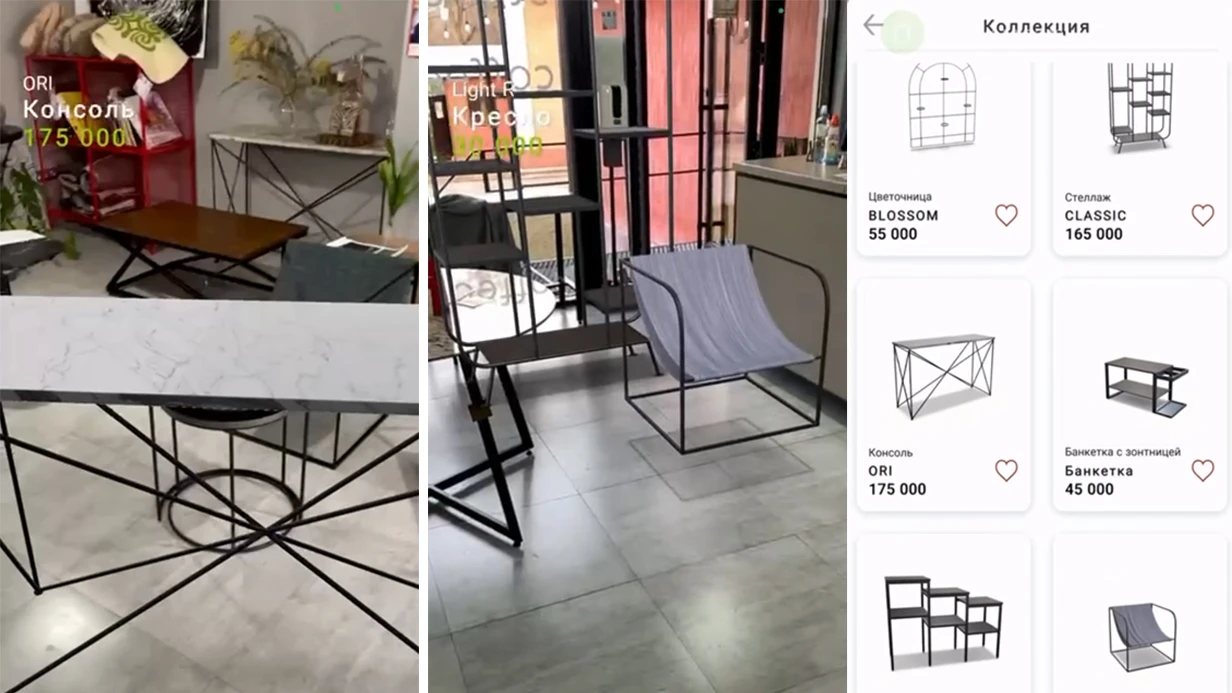
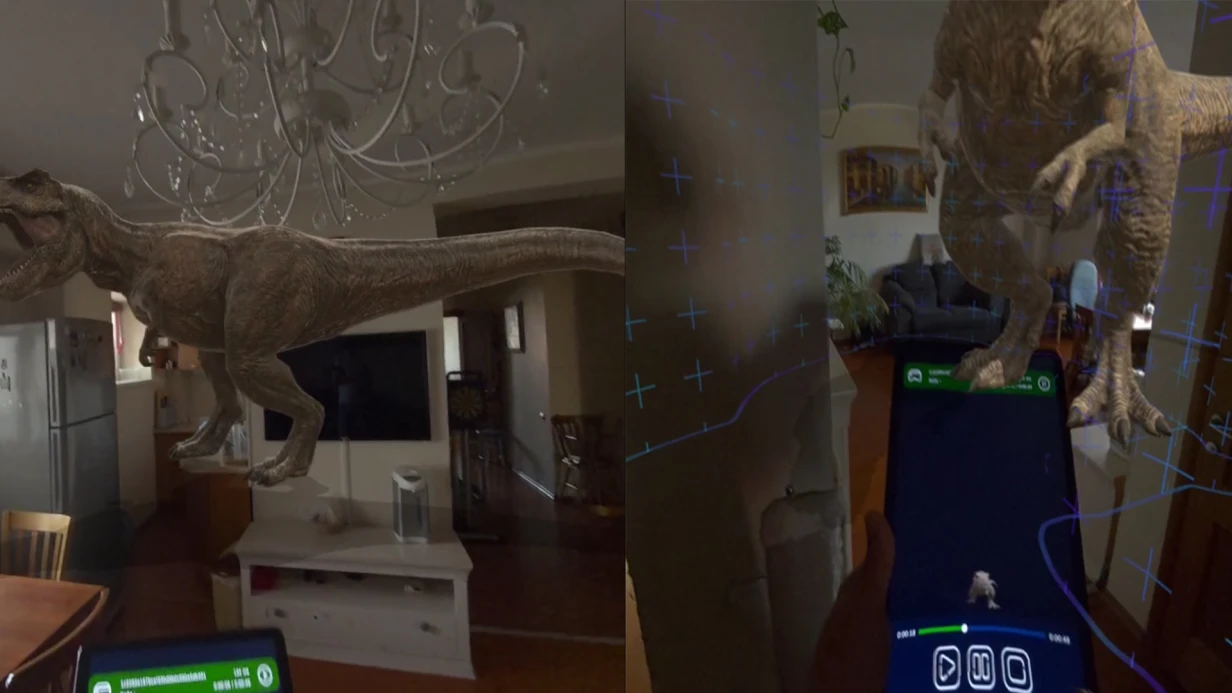
An AR instruction on a tablet shows the mechanic the sequence of operations: which valve to close, what to unscrew — this is critical at remote fields.
MR modeling makes it possible to see before installation begins how a pipeline will run and where intersections with existing utilities will occur.
The result — less downtime, fewer incidents, and faster transition of personnel to independent work. Describe your task — we will recommend a format, design the scenario, and deploy the solution at your site.
How implementation works: from first brief to launch
Implementing VR/AR in the oil and gas industry is not a one-time purchase, but a managed process with clear checkpoints. We have structured the process so that the client always sees where the project stands, what is already completed, and what happens next. No one-way street: every decision is agreed with you.
- Brief and diagnostics — we dive into your task: personnel training, equipment monitoring, field presentation, or reporting. We gather requirements from the specialists who will work with the solution and record the goals in a short document — it becomes the foundation of the project.
- Prototype and approval — we create a working prototype of the interface and scenarios. You see the product logic before the main stage and can make changes without unnecessary costs.
- Plan, estimate, contract — a transparent work schedule, team composition, and fixed cost. All changes are only possible through an agreed procedure — no hidden surcharges.
- Development with demos — every two weeks we send a demonstration of the working product. You adjust details while it is still cheap, not after launch.
- Pilot project — we launch the solution with a limited group: employees go through scenarios, and we measure speed, usability, and errors. Based on feedback, we refine the product to match real conditions.
- Launch and handover — we install the system on your devices or server, train administrators, and provide instructions. After launch, we remain on support: we update content, add new scenarios, and consult your team.
What is included in the project delivery package
You get not just an application, but a ready-made working tool that integrates into your processes and delivers value immediately after launch.
The delivery package includes everything needed for full operation — from a deployed solution to a trained team that can work with it independently.
- Deployed WebVR application — a ready-to-launch solution accessible to employees through a regular browser. No complex installs on every computer: open a link — and you are already inside the virtual environment.
- Adaptation to your facilities and regulations — virtual simulators and scenarios are configured to match your real equipment, technological processes, and company standards. Employees practice actions on exactly the components and situations they work with in the field.
- Personnel training and instruction — we conduct sessions for your employees and separately prepare trainers from among your specialists. After handover
Case study: how we reduced downtime and errors at a facility
Work at a remote production site is a constant race against time. Employees arrive on rotation shifts, instruction sessions take hours, and one mistake during equipment preparation can halt the process for an entire shift.
That was the situation for the oilfield services company TechnoNeft: the decision to grant access was based on paper instructions rather than real skills.
We deployed a WebVR simulator that trains personnel right at the facility. The operator goes through all key operations in a virtual environment — from equipment inspection to actions in an emergency.
Unlike ordinary lectures, the training simulates real risk: every incorrect step is visible immediately, and it must be corrected before stepping onto the real site.
What changed
Over six months, emergency shutdowns at the site dropped by 40%. Average preparation time for repair work decreased from 3.5 to 2 hours — that is almost 1.5 hours less downtime per shift.
The number of errors during personnel access authorization fell threefold, and training reports became transparent: the manager can see which employees completed the scenario and who has gaps.
Business impact
For site management, the key metric is not training speed, but savings on production losses and repair costs. Within two months, the company ordered the rollout of the simulator to two more sites and made it part of the standard training for all shifts. Today we are expanding the project with new scenarios to cover the specifics of each field.
How to choose the right format for your task?
The choice between VR, AR, and MR should start not with trendy technology, but with a specific task. Ask yourself three questions: what should the employee learn to do, under what conditions will they do it, and which errors are unacceptable. The answers eliminate half of the formats.
If you need full control of the environment without distractions — for example, practicing emergency actions or working with dangerous equipment — choose VR.
The employee safely repeats a situation until it becomes automatic, and rare scenarios can be rehearsed as many times as needed.
When the task involves a real facility — pump repair, pipeline inspection, component monitoring — AR is more effective. Instructions and checkpoints appear right before the eyes, and the specialist does not get distracted by paper diagrams.
MR suits complex processes where virtual elements need to be combined with physical space and team work.
The decisive criterion is the specifics of your project. Assess where the solution will be used: in the office, at a production site, or in the field. Account for the number of employees, implementation pace, and integration with existing regulations. If in doubt, start with a pilot on a single scenario — it will show the real effect.
We help oil and gas industry clients choose the right format for their task, drawing on experience from dozens of implementations. We will define the criteria, propose the best options, and assess the benefits. The first step is a short review of your task, which already saves budget.
Answers to common questions before starting a project
Most concerns before starting are not about technology, but about partner reliability and the predictability of results. We have collected answers to common questions — so you understand how the work is structured before signing the contract.
What does our team guarantee if the project is delayed or the result is unsatisfactory?
We fix the stages, timelines, and acceptance criteria in the contract. After each stage, you verify the result on your own equipment and accept the work. In over 10 years, not a single project has been halted — we resolve issues before they affect the schedule.
How are risks reduced if requirements change during the process?
At the start, we conduct a survey and interviews with employees — recording scenarios and constraints. Changes during the work are documented separately; you see the impact on timeline and cost and decide for yourself.
Will there be support after launch?
Yes. Development does not end with project delivery: the contract includes support — consultations on updates, adaptation to new headset models, and scenario refinements. You can choose an extended plan with priority response, but the basic level is already included in the cost.
Does the VR solution integrate with existing IT infrastructure?
We integrate the solution into your current environment: data exchange with internal systems, 3D equipment models, and operation on devices already present at facilities.
During the audit, we verify compatibility with your headset fleet and provide a precise list of modifications.
If your question is not here, write to us — it is free and places no obligation. We will provide a detailed answer and show examples from your industry.Discuss your project with an engineer today
Every project in the oil and gas industry is unique in its own way: different facilities, regulations, and safety requirements. That is why, before naming timelines and terms, we need to hear your task.
A free consultation with an engineer is an opportunity to test an idea, clarify details, and understand the real scope of work without taking on any obligations.
During the initial conversation, you briefly describe the process you want to move into a virtual environment, and we propose a suitable format and a rough estimate. This is not a pitch of services, but a substantive review of your situation.
Engineering support at this stage helps reach a shared solution faster and avoid mistakes at the start.
What you get when you contact us:
- Help formulating your task if you are not yet sure where to begin.
- A preliminary estimate of implementation timelines and required resources.
- Format recommendations: WebVR, a mobile application, or a VR simulator for a specific task.
- An understanding of which processes are worth automating first and which are not yet ready for implementation.
- A clear plan of next steps and a list of data that will be needed from your team.
- Engineering support at all stages — from consultation to launch and post-deployment support.
Leave a request for a consultation — an engineer will contact you within one business day. If the task is standard, we will provide a preliminary estimate right after a short conversation.
If a deeper analysis is required, we will prepare a calculation over several days and discuss possible implementation options. This is free and places no obligation on you.